

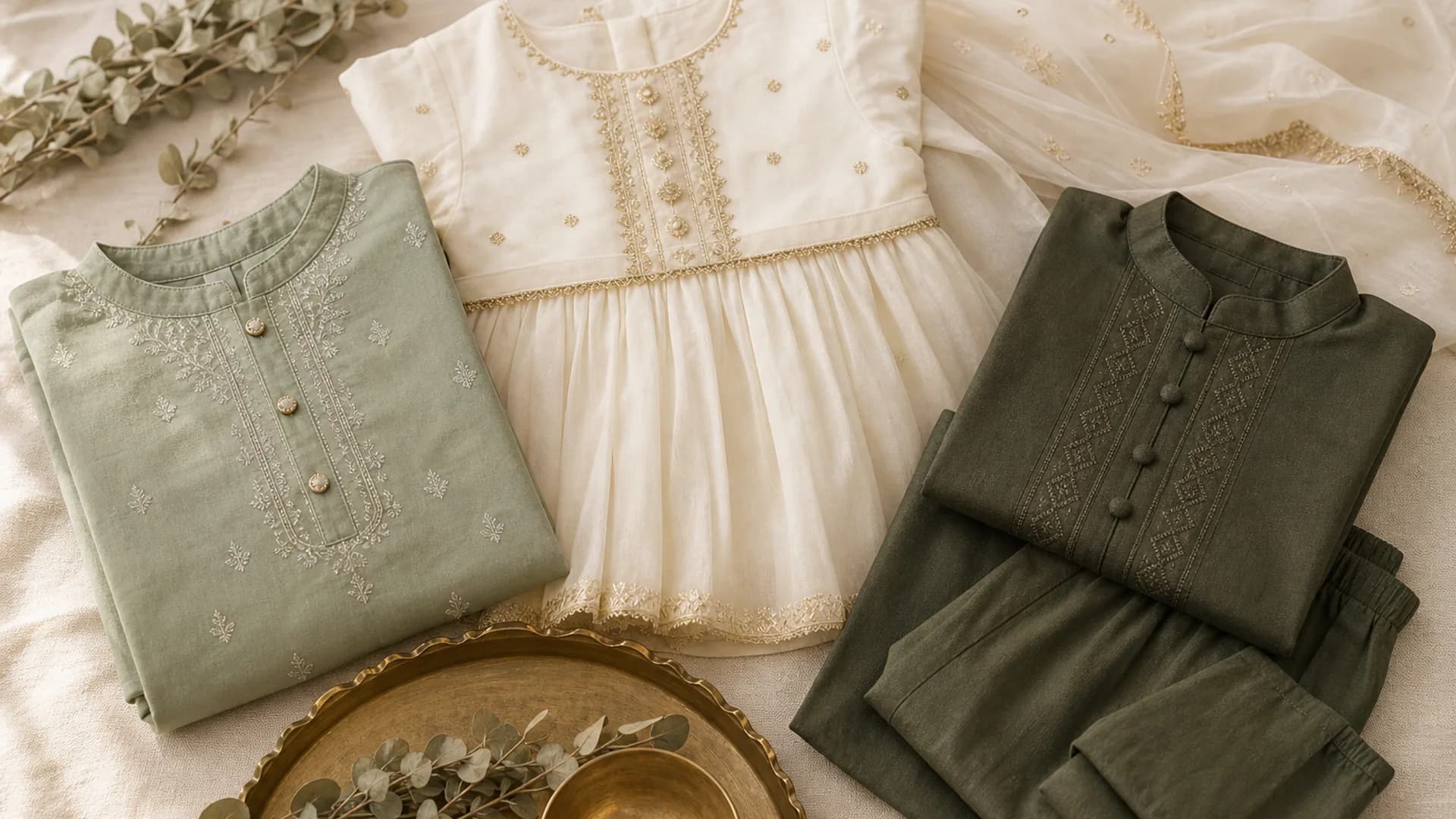
Matching Sibling Outfits for Eid Without the Cliché
Coordinated siblings photograph beautifully. Identical siblings often do not — especially once one of them turns ten. Here is how to get the first without the second.
There is a particular family photograph taken every Eid in Pakistan: three or four children lined up in identical outfits, the youngest delighted, the eldest visibly negotiating an exit. Matching works beautifully up to about age eight. After that it starts to work against you — an older child wants to look like herself, not like a smaller sibling in a larger size. The good news is that coordination and matching are different things, and coordination photographs better anyway. This is how to dress siblings so they look like a family without looking like a uniform.
Matching vs Coordinating: The Distinction That Solves Most Problems
**Matching** means the same outfit in different sizes. Same colour, same cut, same embroidery. **Coordinating** means outfits that share a palette or a detail but differ in cut, tone, or weight. Matching reads as charming on children under eight and as costume above it. Coordinating reads well at every age, and it survives a ten-year-old's opinion. It also photographs better. A row of identical outfits flattens in a photograph — everything reads as one block of colour. Three tones of the same family give the eye somewhere to travel, and each child stays distinguishable. The practical rule: match the palette, vary the piece.
The Three-Tone Method
The simplest approach that always works: pick one colour family and give each child a different depth of it. For example, in green — sage for one, olive for another, deep emerald for the third. In warm neutrals — ivory, sand, and camel. In rose — powder pink, dusty rose, and deep maroon. Usually the youngest takes the lightest tone and the eldest the deepest, which mirrors how formality tends to scale with age anyway. But this is not a rule; assign by what suits each child's colouring. Our guide to [colours for Pakistani skin tones](/journal/best-colours-for-pakistani-skin-tones) is useful here — a shade that lifts one sibling can drain another. The method works with any number of children because you are dividing a range, not repeating a single point.
If you have more children than tones
Repeat a tone but change the fabric or the cut. Two children in the same sage — one in a plain kurta, one in an embroidered frock — still read as distinct.
Coordinating Boys and Girls Together
This is where most families get stuck, because the silhouettes have nothing in common. The answer is to coordinate through a shared element rather than a shared shape. Options that work: **Shared accent colour.** A boy's ivory kurta with sage buttons or piping, alongside a girl's sage frock. The accent ties them together without either wearing the other's outfit. **Shared embroidery motif.** The same floral or geometric work at a boy's collar and a girl's neckline. Subtle, and reads as deliberate in photographs. **Shared neutral base.** Everyone in ivory or cream, with each child's accessories or dupatta providing the individual colour. This is the easiest option and photographs beautifully. What does not work: putting a boy in a colour chosen entirely for the girls' palette. A boy in powder pink because his sisters are in rose will notice, and so will his cousins.
Managing the Older Child
Somewhere around nine or ten, a child stops finding matching charming. This is developmentally normal and worth accommodating rather than overruling. Give the eldest the decision. Let her choose the colour family, then build the younger siblings around her choice. She gets ownership, and the coordination still happens. Give her the most grown-up cut. If the younger ones are in frocks, she gets a proper suit or a longer silhouette. The visual difference is the point — it signals her age within the group rather than flattening it. Let her opt out of the exact shade. If the family palette is rose and she wants deep maroon, that is still coordination. Insisting on the exact tone is what turns this into an argument. And if she genuinely refuses to participate, let it go. A visibly unhappy child in a photograph is worse than a slightly less coordinated one.
Twins, Where the Rules Are Different
Twins are the one case where matching genuinely holds longer, but it depends entirely on the children rather than their age. Some twins like being read as a pair and will happily match well into their teens. Others are actively working to be seen as individuals, and identical outfits undermine that. There is no way to know except to ask. A middle path that works for most: same cut, different colour. The shared silhouette signals the pairing; the different colour preserves individuality. It photographs as intentional rather than lazy. For identical twins specifically, different colours have a practical benefit too — relatives can tell them apart in photographs, which they will appreciate years later.
Coordinating With the Parents
Family photographs work best when the adults sit inside the same palette rather than outside it. The usual mistake is dressing the children carefully and then the parents in whatever was already planned. The children look coordinated and the adults look like guests at someone else's event. The simplest fix: choose the family palette first, then dress everyone from it — adults included. Adults typically take the deepest or most neutral tones, which lets the children carry the lighter, brighter end. If the mother is in a heavily worked outfit, keep the children lighter so the eye has a focal point. If everyone is heavily worked, the photograph becomes noisy. Our [styling guide for accessories with a formal suit](/journal/how-to-match-accessories-formal-pakistani-suit) covers the same balance principle for adults. You can build a family palette from our [ladies collection](/ladies) and [kids collection](/kids) in the same session, which is easier than trying to match after the fact.
Practical Constraints Worth Planning Around
**Buy at the same time.** Dye lots vary. Two pieces in the same nominal shade bought months apart may not match under a camera flash. If you want true tonal coordination, buy together. **Account for different comfort needs.** A ten-year-old will tolerate heavier embroidery than a three-year-old. Coordinating the palette does not mean coordinating the weight — give the youngest the lightest piece. **Check all outfits under the same light.** Colours that coordinate under shop lighting can clash in daylight. Take them to a window together before deciding. **Leave the youngest's outfit slightly generous.** In a group photograph, one child pulling at a tight neckline undoes the whole effect. Comfort is not a separate concern from appearance — it determines it.
The Simplest Version, If You Want One Instruction
Pick one colour family. Give each child a different depth of it. Give the eldest the most grown-up cut and the youngest the lightest weight. Put the adults in the deepest or most neutral tone in the same family. That is the whole method, and it works for two children or six, boys and girls together, across every age range. It also survives contact with reality — nobody has to wear something they dislike, nothing is uncomfortable, and the photograph looks composed rather than costumed. For the pieces themselves, our [kids festive wear guide](/journal/kids-festive-wear-guide-pakistani-weddings) covers what suits which function, and the [embroidered kids suits range](/journal/embroidered-kids-suits-handcrafted-eid-pakistan) is a good starting point for Eid specifically.
Frequently Asked Questions
Around eight to ten, though it depends far more on the individual child than the number. The signal is when they start noticing and commenting rather than enjoying it. Switching from matching to coordinating at that point keeps the family look without the resistance.
Coordinate through a shared accent rather than a shared shape — the same accent colour in his piping and her frock, or the same embroidery motif at his collar and her neckline. Putting a boy into a palette chosen purely for the girls rarely works.
Let her choose the colour family and build the younger children around her choice, and give her the most grown-up cut in the group. She keeps ownership, you keep the coordination. If she still refuses, accept it — an unhappy child ruins a photograph more than a mismatched one.
Only if they want to. Same cut in different colours is the reliable middle path — the shared silhouette reads as a pair while the colour preserves individuality. For identical twins it also helps relatives tell them apart in photographs later.
Dye lots vary between production batches, so two pieces in the same nominal shade bought weeks apart may not match under flash. If exact tonal coordination matters, buy all the outfits in one visit and check them together under daylight before deciding.
About the Author
Habiba Minhas
Founder and creative director of Habiba Minhas, Pakistan's leading handcrafted fashion brand based in Karachi. With a passion for preserving traditional Pakistani craftsmanship while embracing modern design, she has built a brand serving over 5,000 customers nationwide.
Specializing in premium ladies suits, kids festive wear, and baby products, Habiba works directly with artisan embroiderers and skilled tailors to create pieces that honor Pakistani heritage.
Related Articles
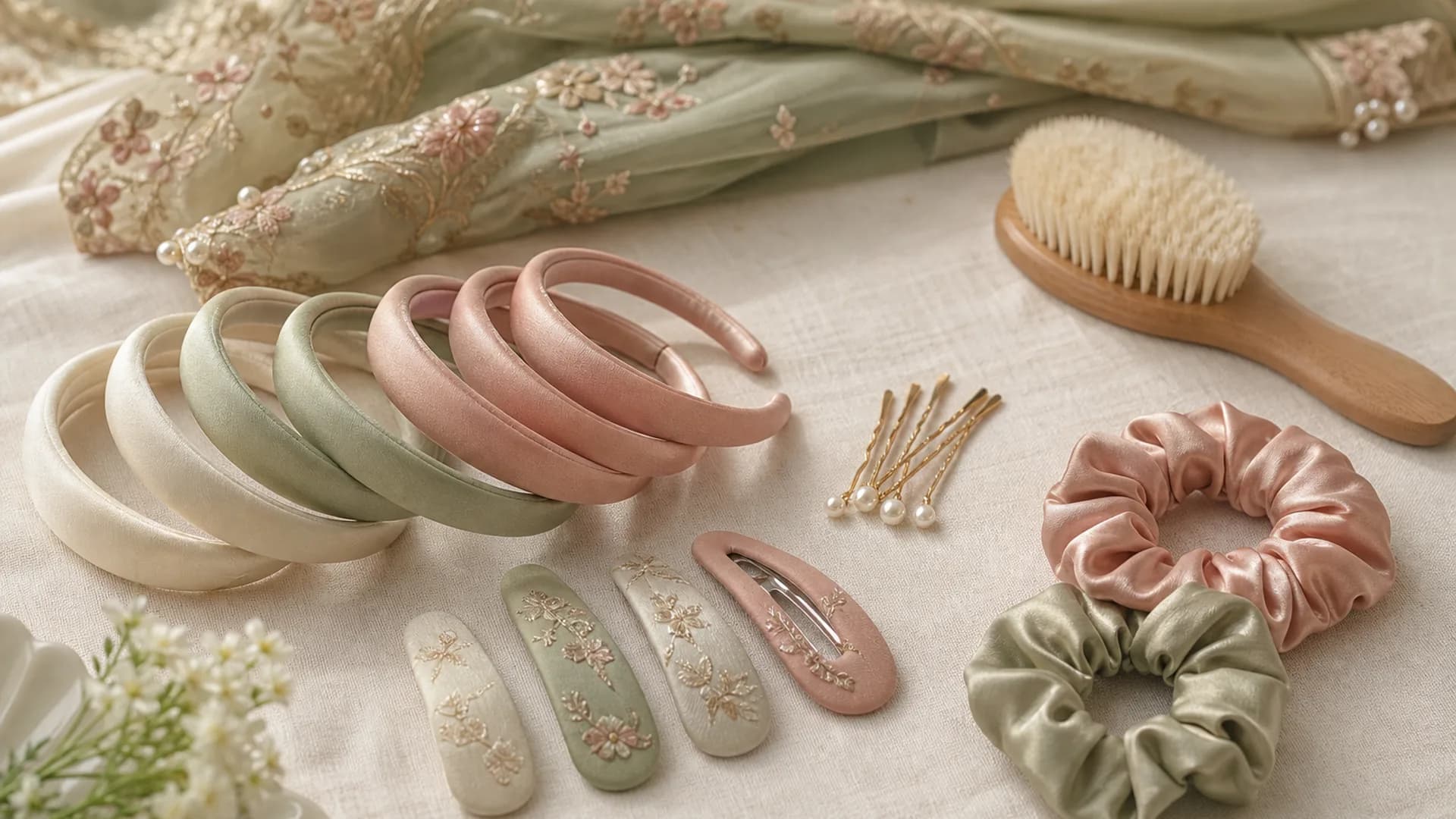
Girls' Hair for Functions: Styles That Survive
The hairstyle is done at six and gone by eight. Here is what actually survives a function, and which accessories stay in.
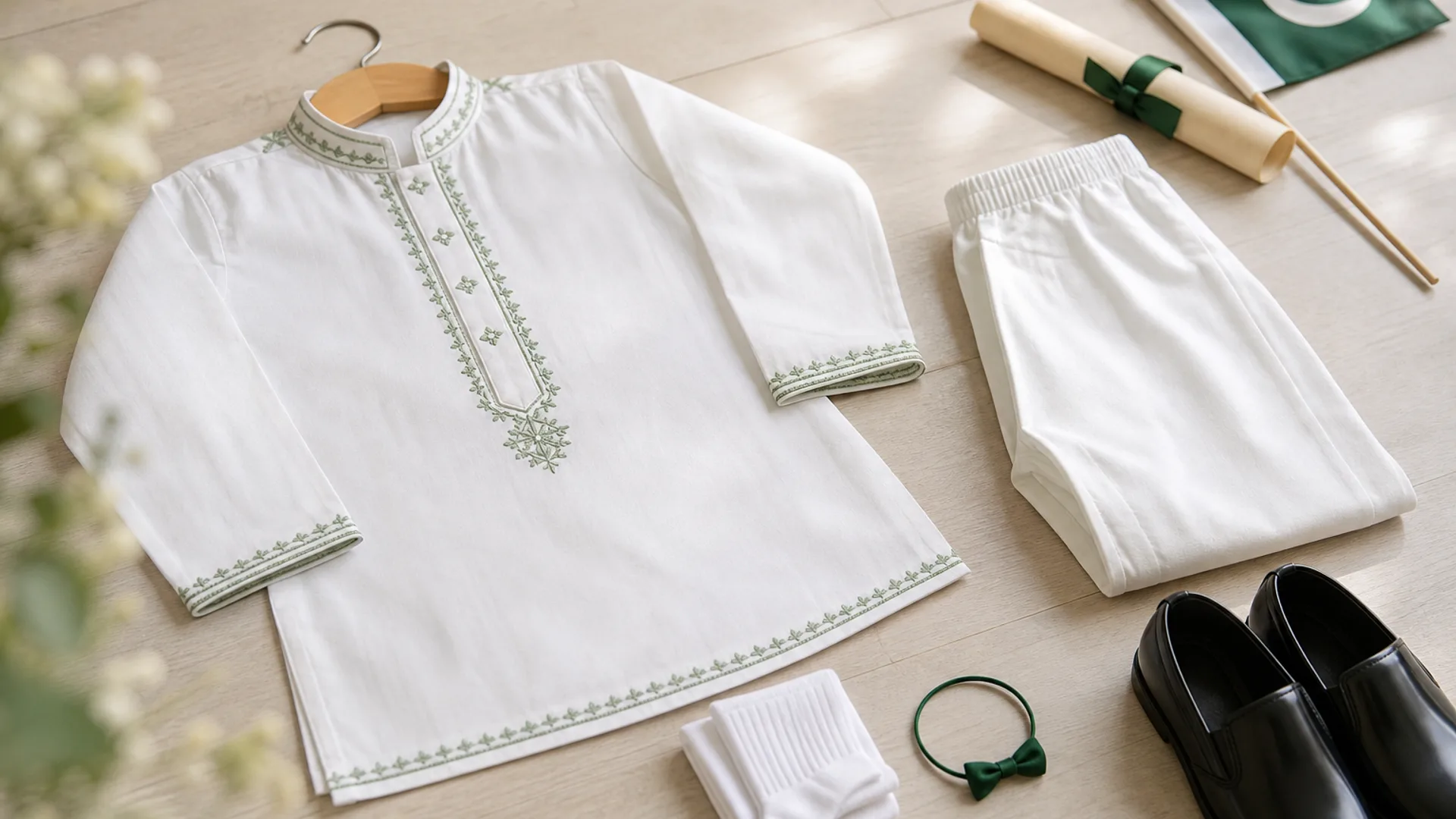
School Functions: What to Dress a Child In
School functions run long, involve a stage, and are rehearsed in the same clothes. Here is what works for each type, and what will be regretted by hour two.
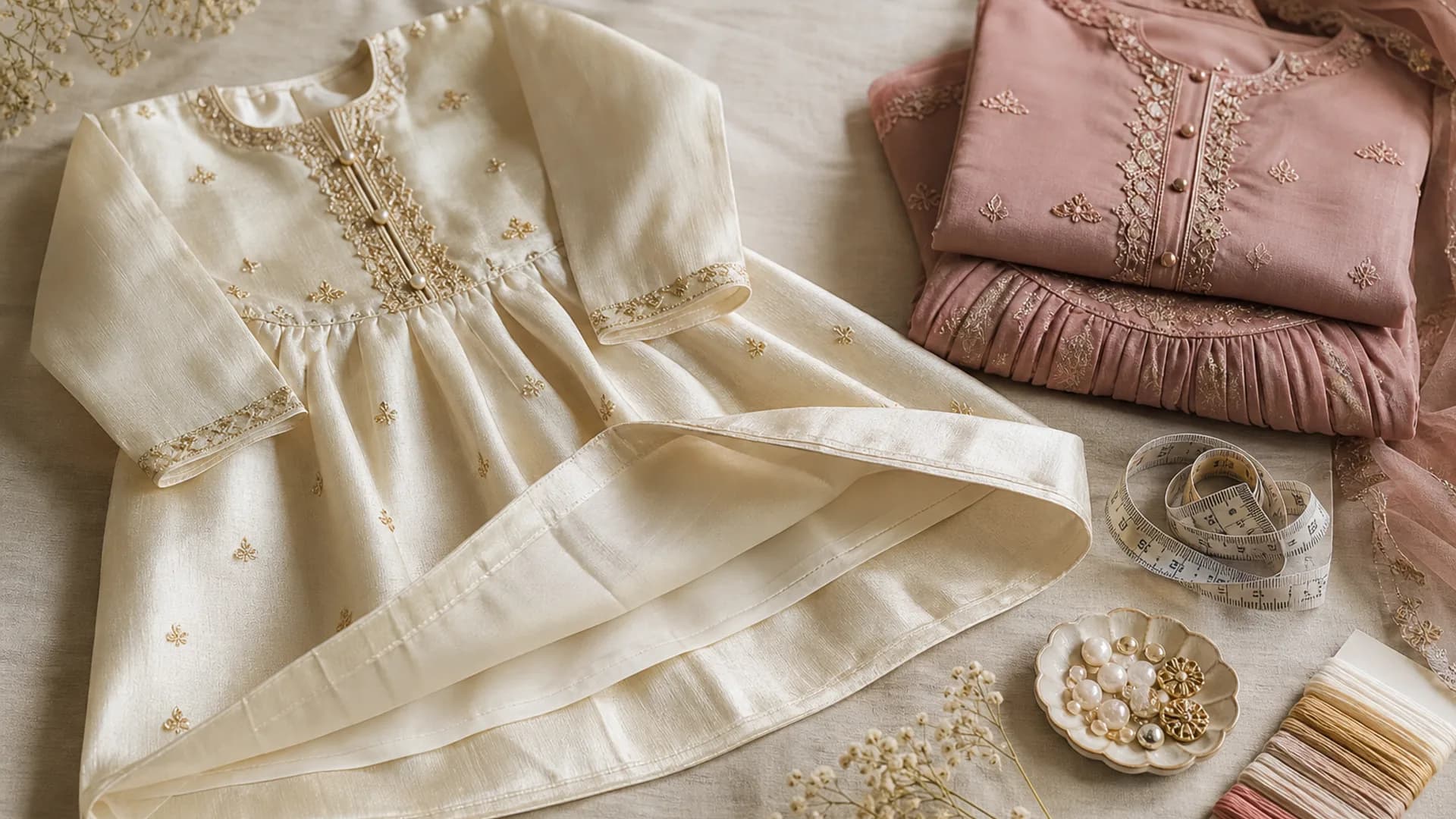
Kids' Formals That Last More Than One Season
A child's formal outfit is worn three or four times before it stops fitting. A few choices at the point of purchase double that, and none of them cost more.