
Building a Formal Wardrobe: The First Five Pieces
Starting with nothing, five well-chosen pieces cover almost every occasion you will be invited to. Here is what they are and the order to buy them in.
Building a formal wardrobe from nothing is usually done backwards: an outfit bought for each occasion as it arrives, in whatever colour was available, with nothing relating to anything else. After three years that produces a cupboard full of clothes and nothing to wear, because every piece is a complete outfit tied to one memory and one photograph. The alternative is to buy pieces that combine. Five well-chosen items cover almost every occasion a Pakistani woman is invited to — weddings, Eid, nikahs, dinners, engagements — and they produce far more than five outfits between them. This is what those five are, in the order worth buying them, and what to leave until later.
One: A Worked Three-Piece in a Jewel Tone
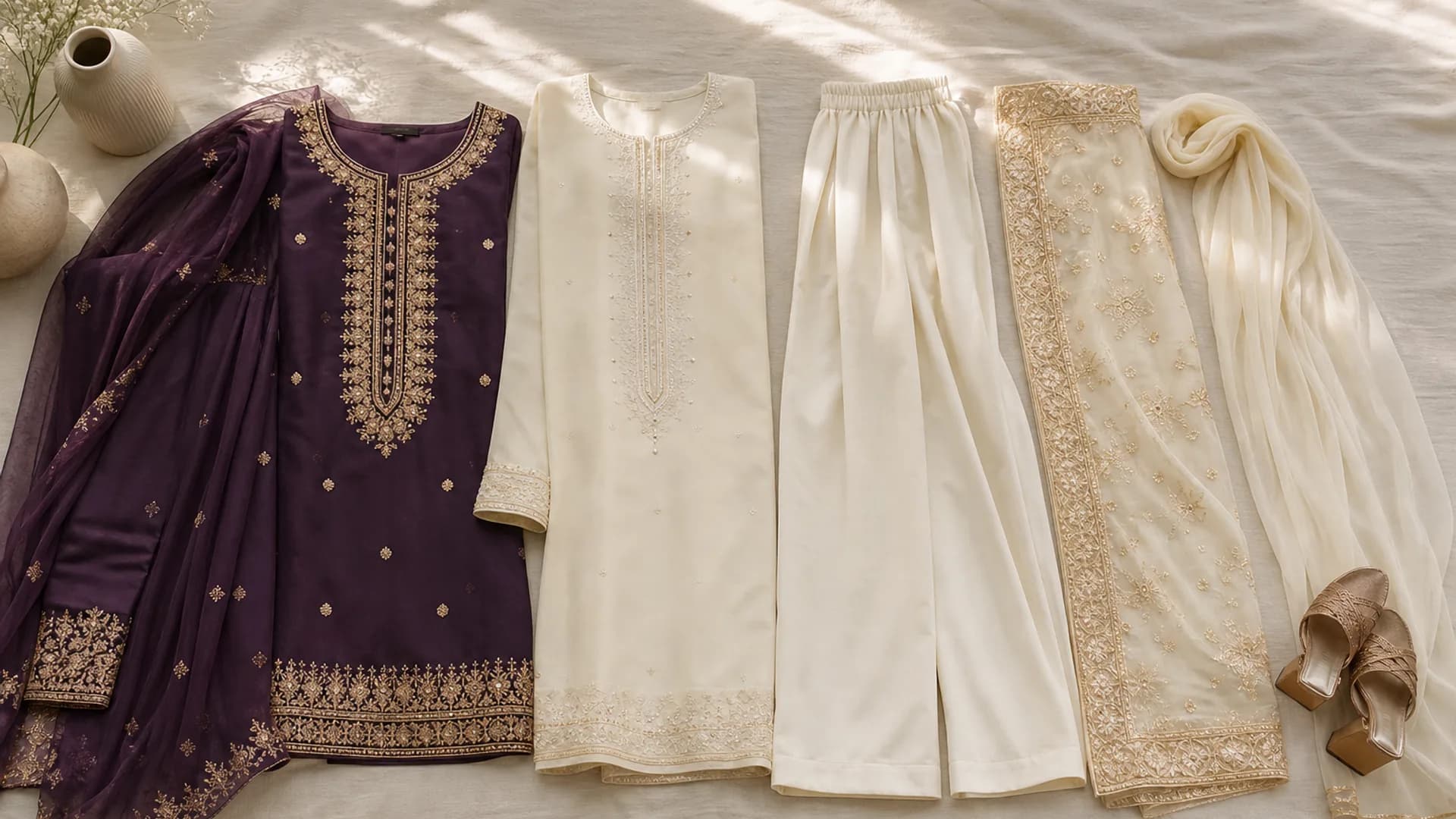
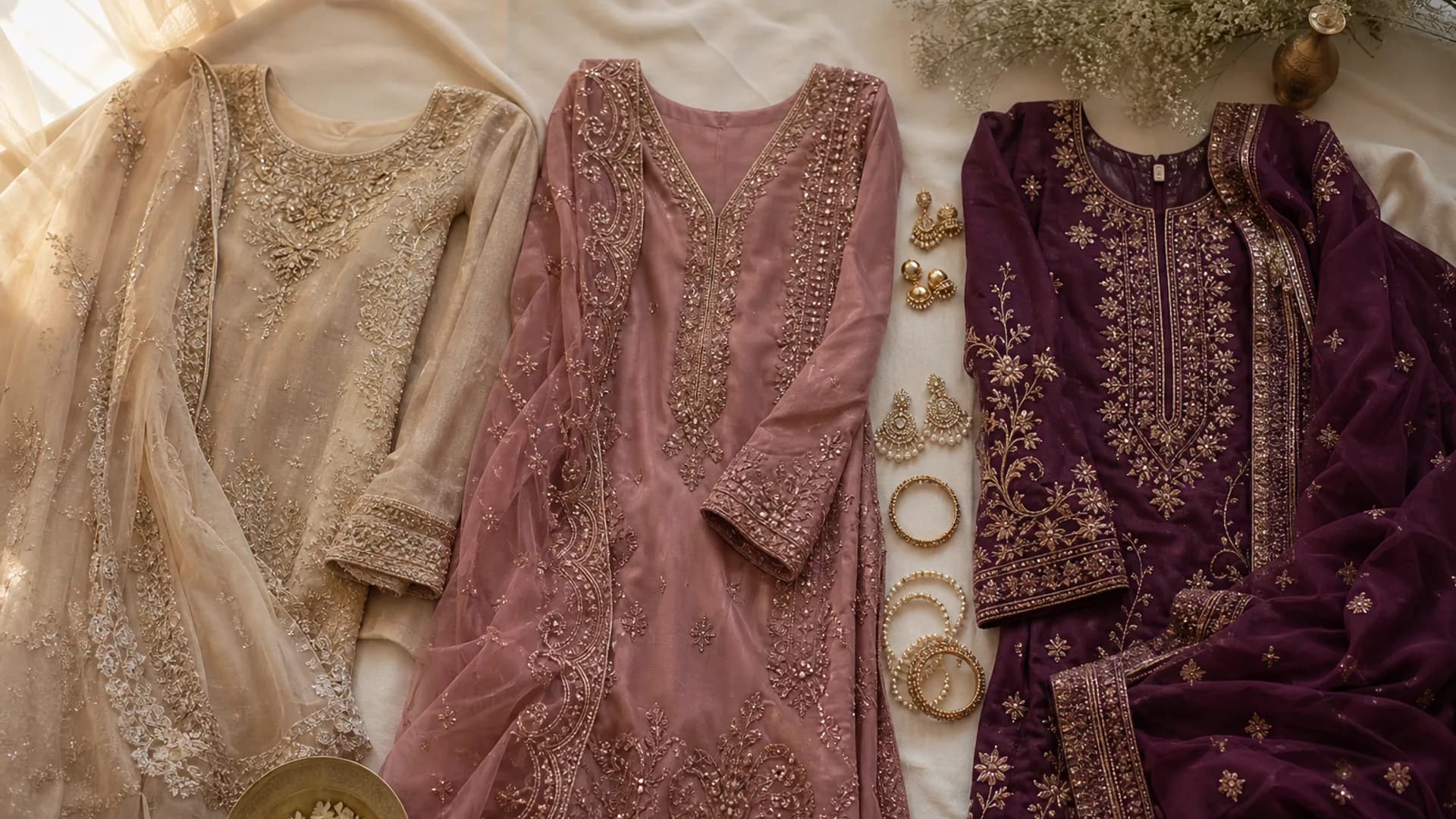
The anchor of the wardrobe and the first purchase. **What to buy:** a full three-piece in raw silk or good chiffon, with placed embroidery at the neckline and hem rather than all over. In a jewel tone — emerald, plum, teal, sapphire — or a rich neutral like bronze or deep gold. **Why this first:** it covers the barat, the walima, an engagement, a formal dinner and Eid evening. It is the outfit you will reach for when the invitation says formal, and it is the one occasion where having nothing suitable is genuinely a problem. **Why a jewel tone:** it photographs well under warm evening lighting, which is what Pakistani functions use, and it suits almost every skin tone. Our post on [photographing well](/journal/what-to-wear-to-photograph-well-functions) covers why pale cool colours struggle in that light. **Why placed rather than all-over work:** it can be dressed down, split up, and worn at a lower level of formality later. All-over embroidery locks a garment to one occasion. **Spend the most here.** Fabric quality over embellishment — our post on [telling real silk from fake](/journal/how-to-tell-real-silk-from-fake-pakistan) covers checking.
Two: A Plain Kameez in a Good Fabric
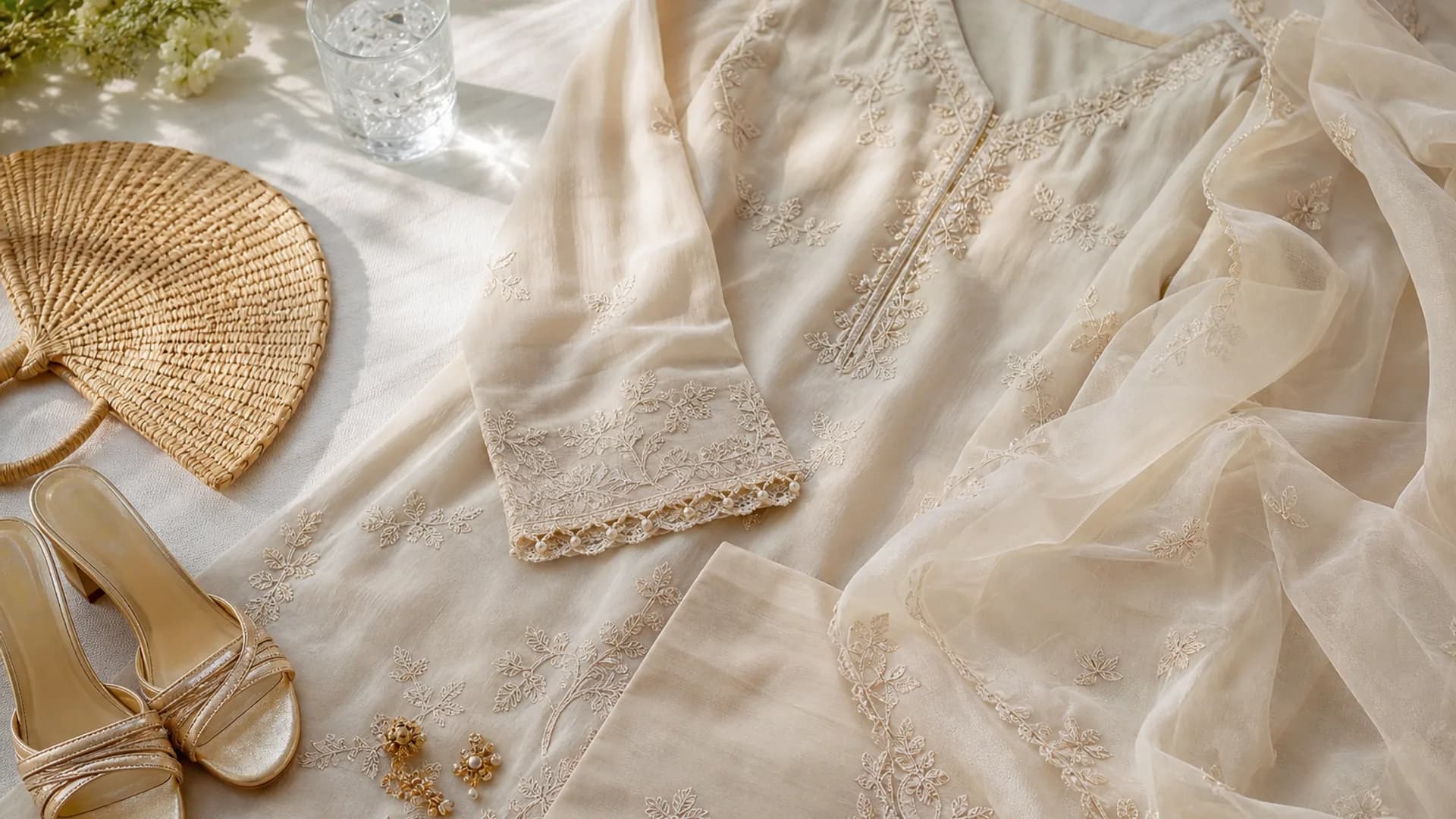
The most-used piece in the wardrobe, and the one nobody buys second. **What to buy:** a plain, well-cut kameez in ivory, champagne or a soft neutral, in raw silk or crepe. No embroidery, or the barest edging at the neckline. **Why:** it is the base that every dupatta works with. A plain shirt with a worked dupatta is a formal outfit; the same shirt with a plain dupatta is a semi-formal one; with everyday trousers it is a good dinner outfit. **Why ivory or champagne specifically:** they suit almost every skin tone, they work with every colour of dupatta and trouser, and they are correct at a nikah where stronger colours are not. Our [nikah guide](/journal/nikah-outfit-guide-guests-pakistan) covers why the pale neutrals dominate that function. **Get the fit right on this one above all.** Because it is plain, the cut is the only thing there is to look at — a plain kameez that fits beautifully looks expensive, and one that fits approximately looks like nothing. Our post on [the five alterations that matter](/journal/five-alterations-make-any-suit-fit) covers what to have adjusted. This is the single highest-value piece per rupee in a formal wardrobe.
Three: Wide-Leg Trousers in Ivory
The piece that multiplies everything else, and the one most people never buy separately. **What to buy:** well-cut wide-leg trousers or a palazzo in ivory or cream, in a good fabric — raw silk or crepe. Flat-fronted rather than heavily gathered at the waist. **Why:** ivory trousers go under almost any shirt you own. Every three-piece becomes two outfits, because the shirt can be worn with its own trousers or with these. **Why wide-leg:** it has replaced the fitted trouser as the standard, it is comfortable, and it suits more body shapes than a churidar does. Our post on [sharara, gharara and palazzo](/journal/sharara-vs-gharara-vs-palazzo-difference) covers the distinctions. **Get the length right and get it hemmed in the shoes you will wear.** A dragging hem is the most visible fit problem there is, and it cancels out everything else. Our [shoes guide](/journal/shoes-with-pakistani-formal-wear-guide) covers choosing the shoe first. **A second pair in black or a deep neutral** is the natural follow-on purchase, though ivory is more useful if you only have one.
Four and Five: Two Dupattas
The cheapest pieces on this list and the ones that do the most work. **Four: a worked dupatta.** Organza or net with a good embroidered border, in gold or a colour that works with your first three pieces. This is what turns a plain kameez into a formal outfit, and it is the most efficient formality you can buy. **Five: a plain dupatta** in soft chiffon or silk, in ivory or a tonal neutral. This is what dresses a formal outfit down for a nikah or a dinner, and it is the one with enough weight to stay on your head when you need it to. **Why two and not one:** the pair lets every outfit go up or down a level. A worked three-piece with its own dupatta is a barat outfit; the same shirt and trousers with the plain dupatta is a nikah outfit. **Buy them generously sized** — around 2.5 metres, and 2.75 if you want to cover your head with something left to drape. Our [dupatta fabric guide](/journal/dupatta-fabric-guide-chiffon-organza-net-silk) covers which fabric does what, and it is worth reading before buying either.
What Five Pieces Actually Give You
Counting the combinations makes the case better than an argument does. **Barat or walima:** the worked three-piece, complete. **A second wedding function:** the worked shirt with the ivory trousers and the plain dupatta. **Nikah:** the plain kameez, ivory trousers, plain dupatta. Correct, restrained and appropriate. **Engagement or formal dinner:** the plain kameez with the worked dupatta and the ivory trousers. **Eid morning:** the plain kameez, worked dupatta, and whichever trousers suit. **Eid evening or a dawat:** the worked three-piece, or the worked shirt dressed down. **A semi-formal dinner:** the plain kameez with everyday trousers. That is seven distinct occasions from five pieces, and it holds up because nothing on the list is locked to a single event. Our post on [restyling what you own](/journal/restyling-old-formal-suits-eight-ways) covers stretching it further, and [planning a wedding wardrobe](/journal/how-many-outfits-pakistani-wedding-week-budget) covers applying it across a whole week.
What to Buy Next
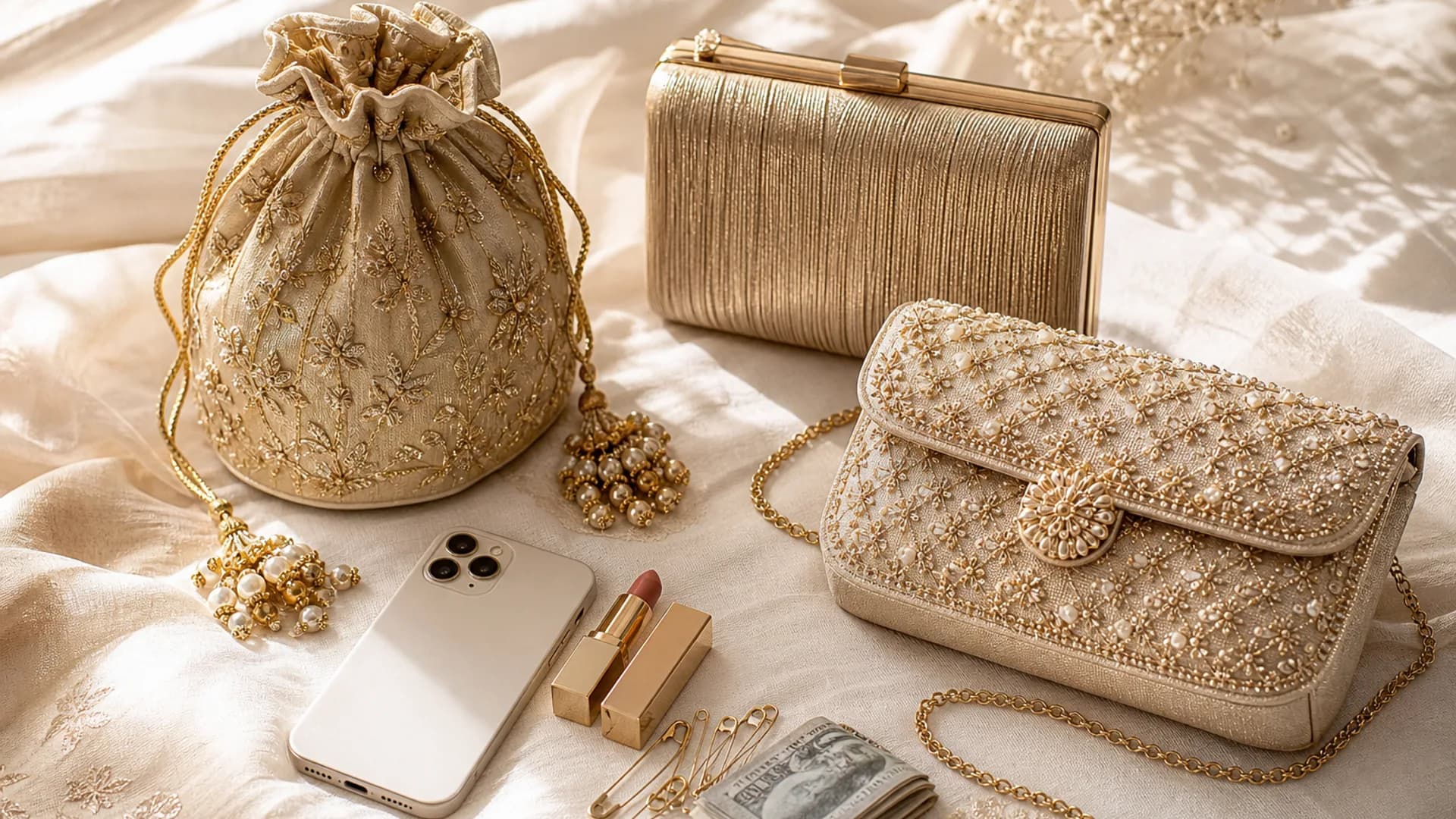
Once the five are in place, the order that adds the most. **Six: one good pair of metallic shoes.** Gold or antique gold, block heel, comfortable. Covers every function and removes the shoe question permanently. **Seven: a clutch with a detachable chain strap** in a matching metal. Our post on [bags and clutches](/journal/bags-and-clutches-with-formal-wear) covers why the strap matters. **Eight: a second worked three-piece**, in a contrasting colour family to the first, so you are not in the same shade at two functions in a season. **Nine: a sharara or a festive outfit** in a bright colour, for mehndis and dholkis, where the formal jewel tones are wrong. **Ten: a good shawl**, in a plain neutral, which covers a whole winter of functions. Our [winter wedding guide](/journal/winter-wedding-guest-outfit-guide-pakistan) covers wearing it over formal wear. **What to leave until much later:** anything heavily embellished, anything in a trend silhouette, and anything you cannot picture wearing twice. Our [capsule wardrobe guide](/journal/capsule-wardrobe-pakistani-women-10-pieces) sets out the fuller ten-piece version.
Buying Rules That Make It Work
Five principles that keep the wardrobe coherent rather than accumulating. **Buy fabric over embellishment, every time.** Heavy work dates quickly and is recognisable in photographs, which is what stops a piece being worn twice. Good fabric in a plain design does neither. **Stay inside two colour families** for the first several purchases. Pieces that relate to each other multiply; pieces that do not, sit alone. **Have everything altered.** A ready-to-wear suit adjusted properly looks made; unaltered it looks approximate. Our [tailor guide](/journal/working-with-a-tailor-darzi-guide) covers briefing, and the [size guide](/content/size-guide) has our measurements to compare against. **Ask whether it can be split.** If a piece only works as a complete matched set, it is one outfit rather than three. **Buy for the occasions you actually attend**, not the ones you might. Most people go to two or three formal events a year, not ten. You can see the range across the [ladies collection](/ladies), the [3-piece suits](/ladies/3-piece-suits) and the [stitched suits](/ladies/stitched-suits), and the [Virtual Try Room](/virtual-try-room) will show you how a colour sits before you commit to the first purchase.
Frequently Asked Questions
A worked three-piece in raw silk or good chiffon, in a jewel tone or rich neutral, with embroidery placed at the neckline and hem rather than all over. It covers the barat, walima, engagements and formal dinners, and placed work means it can be dressed down later.
Five pieces — a worked three-piece, a plain kameez, ivory wide-leg trousers, a worked dupatta and a plain dupatta — cover about seven distinct occasions between them, because nothing on the list is locked to a single event. Most people attend two or three formal events a year.
Because it is the base every dupatta works with. A plain shirt with a worked dupatta is formal; with a plain dupatta it is semi-formal; with everyday trousers it is a dinner outfit. It is the highest-value piece per rupee in a formal wardrobe, and the one nobody buys second.
Fabric, every time. Heavy work dates quickly and is instantly recognisable in a photograph, which is exactly what stops you wearing a piece twice. A good silk in a well-chosen colour is not recognisable, does not date, and can be dressed up or down.
Anything heavily embellished, anything in a trend silhouette, and anything that only works as a complete matched set — a piece that cannot be split is one outfit rather than three. Also avoid buying outside two colour families until the basics are in place.
About the Author
Habiba Minhas
Founder and creative director of Habiba Minhas, Pakistan's leading handcrafted fashion brand based in Karachi. With a passion for preserving traditional Pakistani craftsmanship while embracing modern design, she has built a brand serving over 5,000 customers nationwide.
Specializing in premium ladies suits, kids festive wear, and baby products, Habiba works directly with artisan embroiderers and skilled tailors to create pieces that honor Pakistani heritage.
Related Articles
Bags and Clutches With Pakistani Formal Wear
The bag is chosen last, matched to the outfit, and then turns out to hold nothing you need. Here is how to pick one that works for a five-hour function.
Summer Wedding Guests: Staying Cool and Formal
A summer wedding in Pakistan is an endurance event. The outfit that works is chosen for airflow and weight, not for how it photographs in a shop.
What the Bride's Sisters Should Wear
Sisters of the bride have the hardest brief at a Pakistani wedding: photographed constantly, working the whole time, and required not to outshine anyone.