

What the Bride's Sisters Should Wear
Sisters of the bride have the hardest brief at a Pakistani wedding: photographed constantly, working the whole time, and required not to outshine anyone.
The bride's sisters have the hardest brief of anyone at a Pakistani wedding. They are in more photographs than any guest, across every function, standing next to the bride in most of them. They are also working the entire time — receiving people, managing the family, carrying things, fixing problems, and staying up until the last guest leaves. And they are expected to look excellent while doing all of it, without pulling focus from the bride. Those requirements pull against each other. The outfit that photographs best is rarely the one you can work in for six hours, and the one that stands out most is exactly the one you should not be wearing. Here is how to resolve it.
Coordinate, Do Not Match
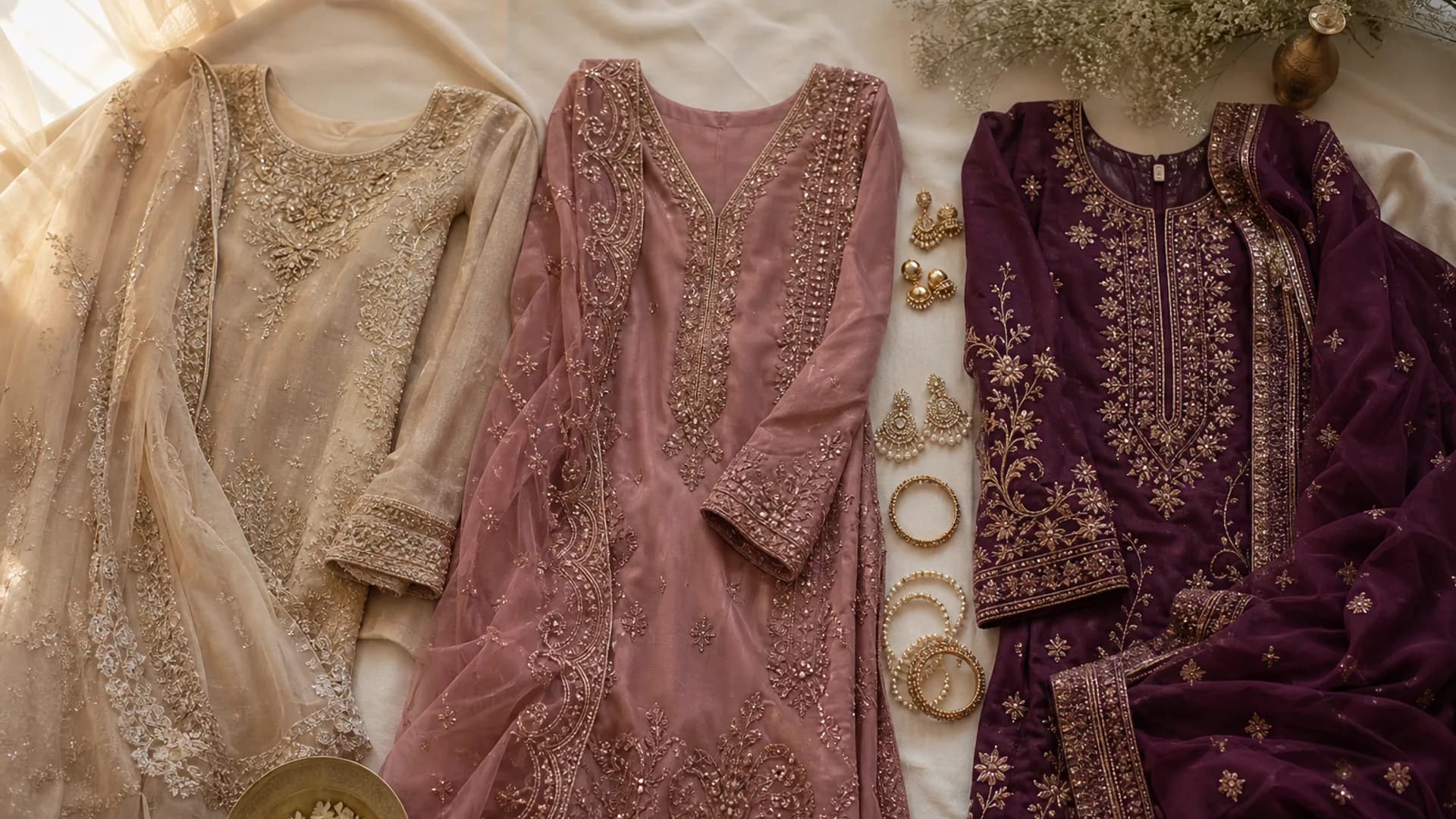
The single most useful decision, and it should be made early with everyone in the room. **Agree a palette, not an outfit.** All the sisters in one colour family at different depths — a pale, a mid-tone and a deep — photographs considerably better than everyone in identical outfits, and it lets each person choose a shade that suits her. **Identical outfits are a mistake** for a group of adults. They flatten everyone to the least flattering common denominator, and one shade cannot suit four different skin tones. **Vary the depth deliberately.** Three people in the same mid-tone merge into one shape in a group photograph. A pale, a mid and a deep read as three distinct figures. Our post on [photographing well](/journal/what-to-wear-to-photograph-well-functions) covers why. **Let the silhouettes differ.** One in a sharara, one in a straight three-piece, one in an anarkali — in a shared palette this reads as considered rather than uncoordinated. **Agree it in writing.** "Dusty rose to plum family, no red, no ivory" in a group message avoids the conversation on the day.
Staying Out of the Bride's Territory
Not out of modesty, but because it is her day and a photograph with two people in bridal red is a photograph nobody is happy with. **Ask what she is wearing for every function**, not just the barat. This is the single most important question and the one most often asked too late. **Avoid her exact colour**, and avoid the shade next to it. Being nearly the same is worse than being clearly different, which is the same principle that governs matching a dupatta. Our post on [colour matching](/journal/matching-dupatta-trouser-to-shirt-colour) covers why near-matches read badly. **Red at the barat is hers.** So is whatever she has chosen for the mehndi and walima. **Avoid full bridal-level embellishment.** Sisters can and should be formal; the heaviest, most worked outfit in the room should not be on a sister. **Skip the bridal accessories** — maang tikka, jhoomar, heavy nath. Statement earrings and a good necklace do the job without reading as bridal-adjacent. **Ivory at the nikah is worth checking**, since it is often the bride's palette for that function specifically. Our [nikah guide](/journal/nikah-outfit-guide-guests-pakistan) covers the wider question.
You Are Working, So Dress for Work
This is the part that gets forgotten every time, and it decides whether the week is enjoyable. **You will be on your feet for five or six hours per function.** Low block heels or elegant flats. A stiletto on a lawn is unusable, and by hour three you will be barefoot. Our [shoes guide](/journal/shoes-with-pakistani-formal-wear-guide) covers the venue question. **You will be carrying things, hugging people and helping the bride.** A dupatta that needs holding is a dupatta you cannot work in. Pin it at the shoulder — our [draping guide](/journal/7-ways-drape-dupatta-weddings-formal-events) has the styles that stay. **Nothing with a train, nothing floor-sweeping.** You will be walking through crowds and up and down stairs. **Nothing that restricts your arms.** A cape or bell sleeve cannot be pushed up and gets in the way constantly. Our [sleeve guide](/journal/kameez-sleeve-styles-guide) covers which shapes are practical. **Check you can sit on a floor in it.** At the mehndi and dholki you will be sitting cross-legged. **Test the whole outfit for an hour at home**, moving around, before the day.
Planning Across the Whole Week
Sisters need more outfits than anyone except the bride, and planning them together is what keeps it manageable. **Five functions usually means four outfits**, with one repeated where the guest lists differ. **Dholki:** something you already own. Bright, comfortable, floor-friendly. Do not spend here. **Mehndi:** festive and comfortable enough to dance in. A sharara or worked kurta. **Nikah:** restrained, ivory or soft tones, with a dupatta that stays on your head. **Barat:** the main spend. This is the most photographed function and where the formal outfit belongs. **Walima:** the barat outfit with a different dupatta and jewellery, or a second formal piece. **Plan the colours as a set**, so you are not in the same family twice in a week. Vary the depth across the functions as well as across the sisters. Our post on [planning a wedding wardrobe](/journal/how-many-outfits-pakistani-wedding-week-budget) covers the arithmetic, and [restyling what you own](/journal/restyling-old-formal-suits-eight-ways) covers making a repeat read as new.
Where to Spend and Where Not To
**Spend on the barat outfit.** It is the most photographed function and the piece most likely to be worn again at other weddings for years. **Spend on fabric rather than embellishment.** Heavy work is instantly recognisable in a photograph, which is exactly what stops you wearing it again — and as a sister you will be at other weddings in the same circle. A good silk in a well-chosen colour is not recognisable and does not date. Our post on [telling real silk from fake](/journal/how-to-tell-real-silk-from-fake-pakistan) covers checking what you are paying for. **Spend on a good dupatta**, which gives you a second outfit from the same shirt and trousers. **Do not spend on the dholki outfit.** Something you own is correct. **Do not buy four pairs of shoes.** One good metallic block heel and one comfortable flat covers the week. **Order early.** Alterations take time, tailors are overwhelmed in wedding season, and a sister's outfit is not the one to rush. Our [tailor guide](/journal/working-with-a-tailor-darzi-guide) covers briefing properly, and the [shipping page](/help/shipping) has delivery timings.
Practical Kit for the Week
You will be the one everyone comes to when something goes wrong, so carry the things that fix it. **Safety pins, in two sizes.** The most useful item at any Pakistani wedding, and you will use all of them. **A small sewing kit** with thread matching everyone's outfits. **Double-sided fashion tape.** **Spare hooks and buttons.** **A lint roller**, which matters most on dark outfits. **Blister plasters**, for yourself and for everyone else. **A folding flat pair of shoes** in a bag. **Spare hair pins and elastics**, for you, the bride, and every child present. **A phone charger.** You will be coordinating everything. Our [packing guide](/journal/packing-formal-wear-travel-without-creasing) covers travelling with the outfits if the wedding is in another city, and it is worth reading if you are carrying four formal outfits somewhere.
A Note on the Whole Thing
One thing worth saying, because the pressure on sisters at a Pakistani wedding is genuinely high and largely invisible. You will be compared, photographed and commented on more than any guest, by people who are not doing any of the work you are doing. That is not a reason to spend more than you can afford, or to be uncomfortable for five days. **A well-fitting simple outfit in a good fabric beats an elaborate one that does not fit**, in person and considerably more so in photographs. Fit is what shows. Our post on [the five alterations that matter](/journal/five-alterations-make-any-suit-fit) covers getting it right, and the [size guide](/content/size-guide) has our measurements. **Repeating is normal and almost nobody notices.** Change the dupatta, the jewellery and the hair. **Comfort is not a compromise.** The sisters who look best at the end of the night are the ones who are not in pain. You can see the formal range across the [ladies collection](/ladies) and the [3-piece suits](/ladies/3-piece-suits), and the [Virtual Try Room](/virtual-try-room) is useful for agreeing a family palette without everyone shopping together.
Frequently Asked Questions
Coordinate rather than match. Agree a colour family and vary the depth — a pale, a mid-tone and a deep shade read as three distinct figures in a photograph, while identical outfits flatten everyone to the least flattering common denominator and cannot suit several skin tones at once.
The bride's colour for each function, and the shade next to it — being nearly the same reads worse than being clearly different. Red at the barat is hers. Ask what she is wearing for every function, not just the main one, and check ivory at the nikah.
Usually four across five functions, with one repeated where the guest lists differ. Something you already own for the dholki, festive for the mehndi, restrained for the nikah, the main spend on the barat, and the barat outfit restyled for the walima.
That you are working. Five or six hours on your feet per function, carrying things and helping the bride. Low block heels or flats, a dupatta pinned at the shoulder rather than one you have to hold, nothing floor-sweeping and nothing that restricts your arms.
The barat outfit, and within it on fabric rather than embellishment. Heavy work is instantly recognisable in photographs, which stops you wearing it again at other weddings in the same circle. A good silk in a well-chosen colour is not recognisable and does not date.
About the Author
Habiba Minhas
Founder and creative director of Habiba Minhas, Pakistan's leading handcrafted fashion brand based in Karachi. With a passion for preserving traditional Pakistani craftsmanship while embracing modern design, she has built a brand serving over 5,000 customers nationwide.
Specializing in premium ladies suits, kids festive wear, and baby products, Habiba works directly with artisan embroiderers and skilled tailors to create pieces that honor Pakistani heritage.
Related Articles
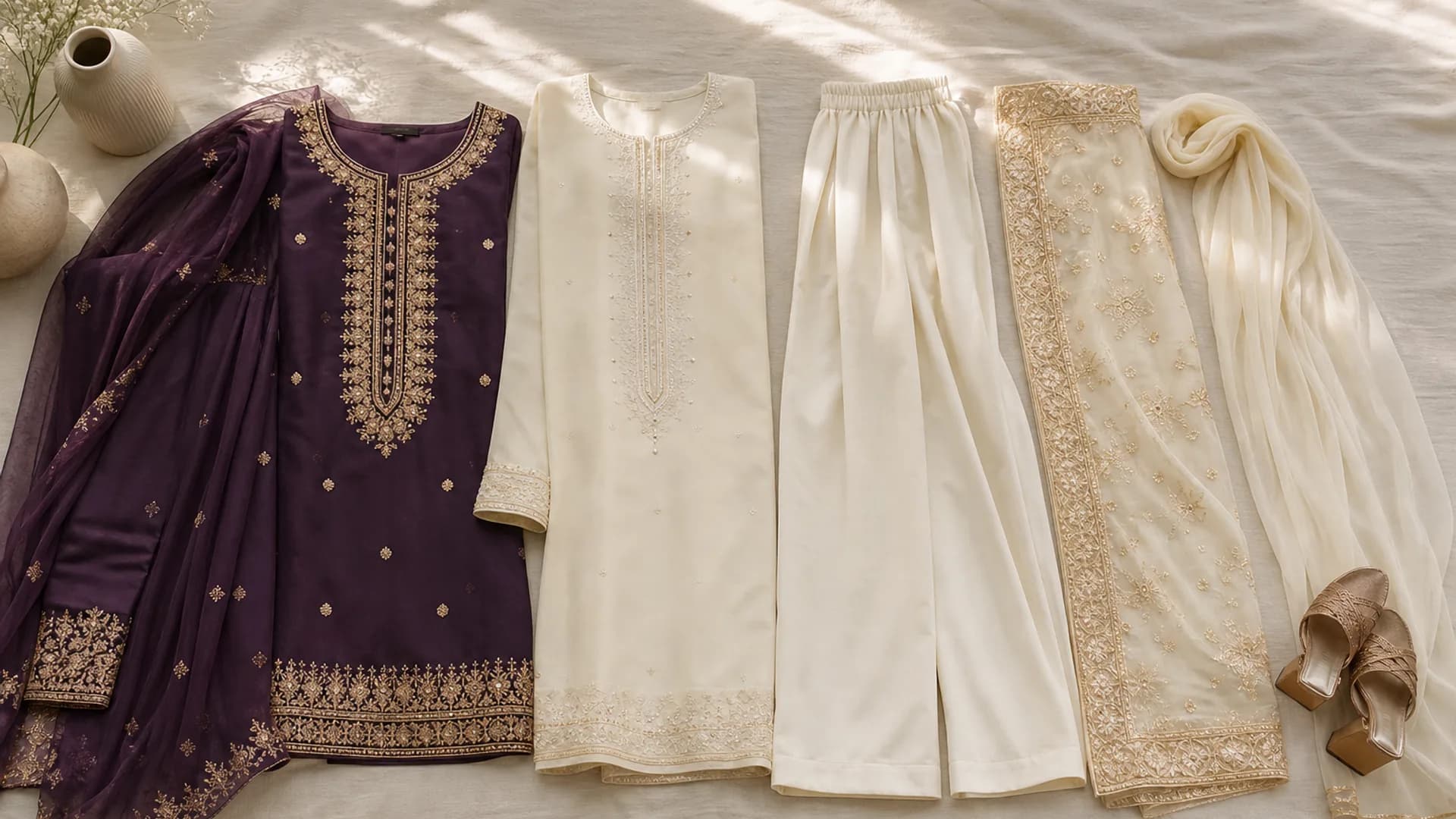
Building a Formal Wardrobe: The First Five Pieces
Starting with nothing, five well-chosen pieces cover almost every occasion you will be invited to. Here is what they are and the order to buy them in.
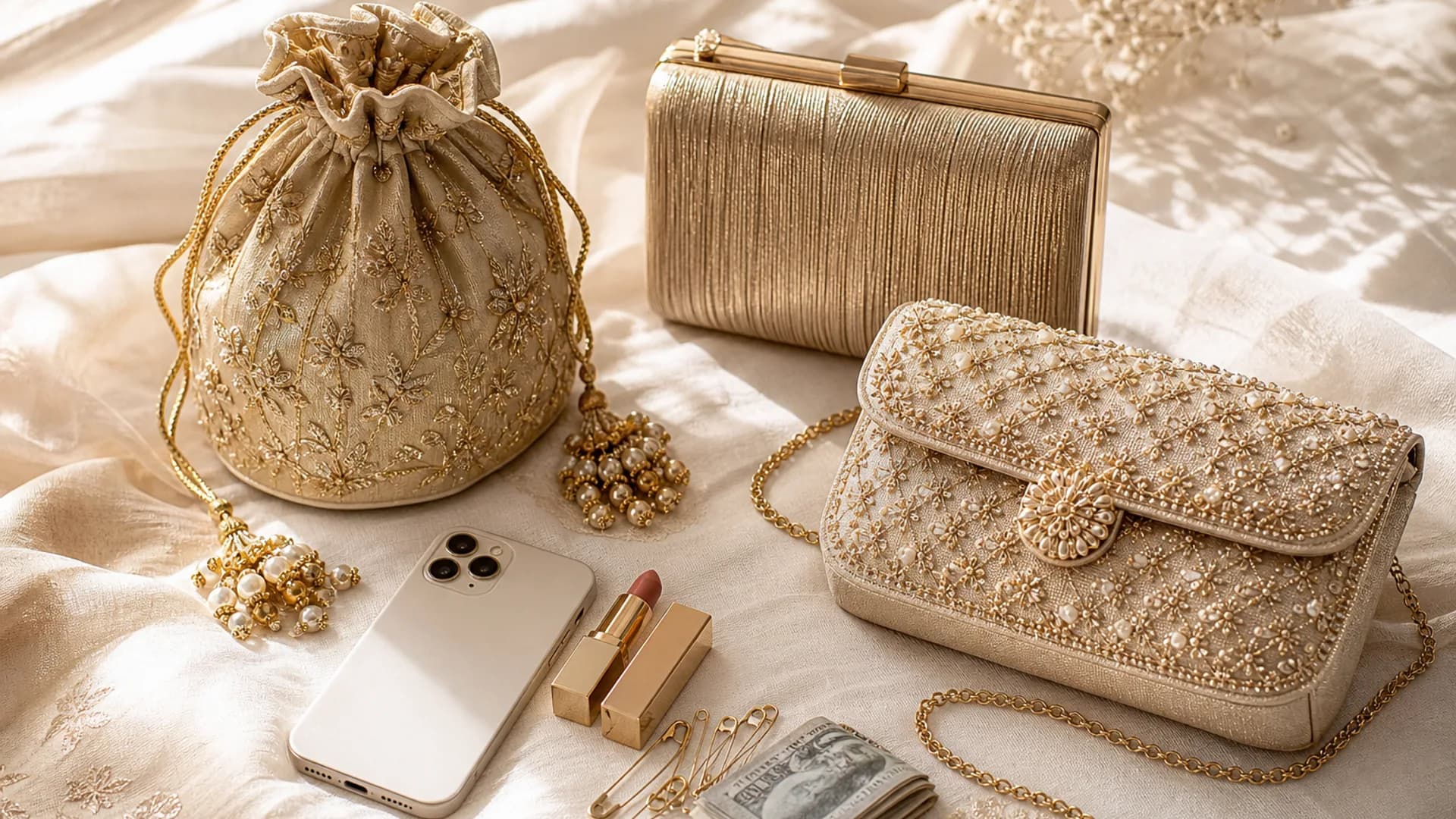
Bags and Clutches With Pakistani Formal Wear
The bag is chosen last, matched to the outfit, and then turns out to hold nothing you need. Here is how to pick one that works for a five-hour function.
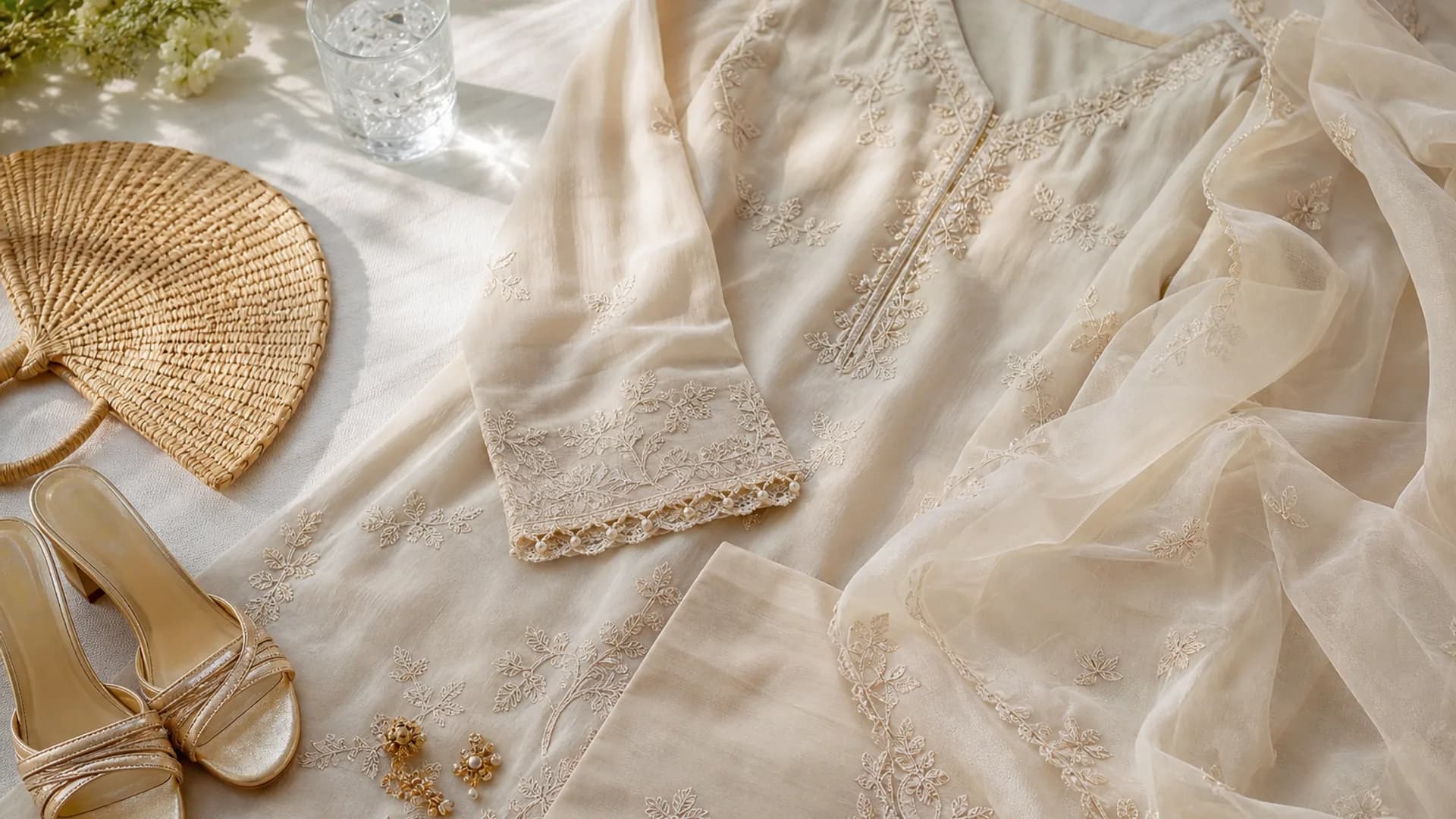
Summer Wedding Guests: Staying Cool and Formal
A summer wedding in Pakistan is an endurance event. The outfit that works is chosen for airflow and weight, not for how it photographs in a shop.