

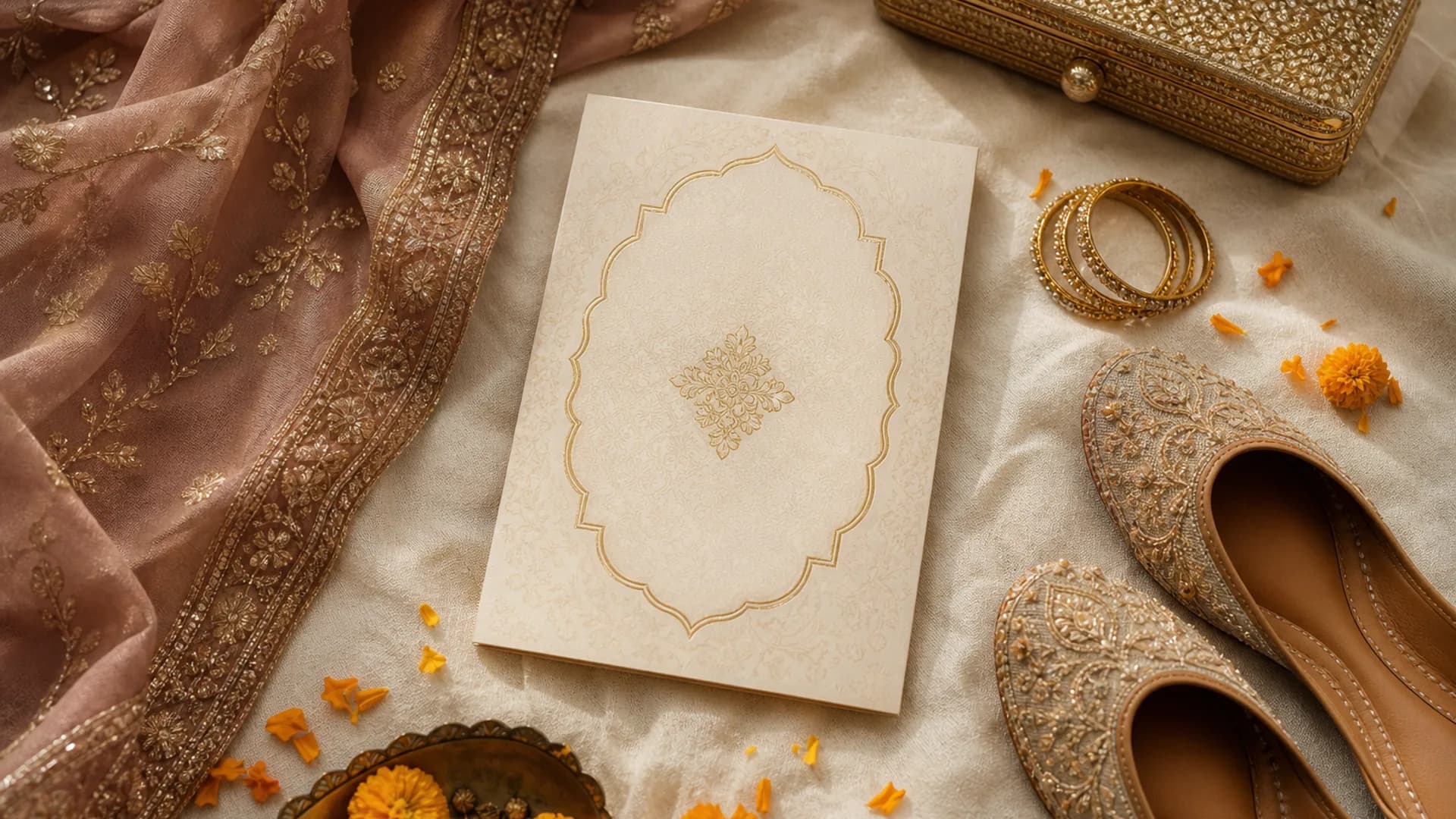
Your First Pakistani Wedding: What to Expect
Several functions, several days, and an invitation that explains none of it. Here is what each event is, when it actually starts, and what to wear.
If you have been invited to a Pakistani wedding and it is your first, the invitation will not have told you much. It gives dates, venues and times. It does not explain that there are several distinct events, that they have different dress codes, that the stated start time is not when anything starts, or that you may be seated with the women. None of this is a secret. It is simply assumed knowledge, and nobody thinks to explain it because everybody they know already knows. So this is the version nobody gets given: what each function is, what to wear to it, when things actually happen, and the small number of things that would be genuinely awkward to get wrong.
The Functions, in Order
A full Pakistani wedding runs across several days. You will not necessarily be invited to all of them. **Dholki.** Informal music evenings held at home in the run-up, sometimes several. Singing, dhol drumming, sitting on the floor. Casual and warm. **Mayoun or ubtan.** A small family ritual before the wedding, usually close family only. **Mehndi.** The big colourful pre-wedding celebration. Music, dancing, yellow and green and orange everywhere, henna. Loud, long and enjoyable. **Nikah.** The religious ceremony and the legal marriage itself. Short, quiet, often in a mosque or a home. This is the actual wedding. **Barat.** The groom's party arrives at the bride's event. The most formal function of all, and usually the largest. **Walima.** The reception hosted by the groom's family, typically the day after. Formal, and slightly more relaxed than the barat. Most guests are invited to the barat and walima, sometimes the mehndi. If you have been invited to a dholki, that means you are close to the family.
What to Wear to Each
The functions sit at different levels of formality and it is a genuine mistake to treat them as one. **Dholki.** Bright, comfortable, informal. A cotton or lawn kurta with trousers. You will be sitting on the floor. Our [dholki guide for children](/journal/how-to-dress-kids-pakistani-dholki-night) describes the setting well, and the same logic applies to adults. **Mehndi.** Bright and festive — yellow, orange, fuchsia, parrot green. A sharara or a worked kurta. Comfortable enough to dance in. Our [mehndi guide](/journal/what-to-wear-mehndi-night-pakistan) covers it fully. **Nikah.** Restrained and modest — ivory, champagne, pastels. Sleeves, and a dupatta large enough to cover your head. Our [nikah guide](/journal/nikah-outfit-guide-guests-pakistan) is worth reading before this one specifically. **Barat.** The most formal. A worked three-piece, sharara or gharara in silk or velvet, in a jewel tone or rich neutral. Our [barat guide](/journal/barat-outfit-ideas-guests-pakistan) has the detail. **Walima.** Formal, slightly less heavy than the barat. Our [walima guide](/journal/walima-guest-outfit-guide-pakistan) covers it. If you take one thing from this: **you cannot underdress at a Pakistani wedding.** Guests dress up considerably more than at most Western weddings, and the risk is being too plain rather than too much.
The Colours to Think About
Only a few restrictions exist, and they are easy to observe. **Red at the barat** is the bride's. Traditional Pakistani brides wear red or deep maroon at the barat, and a guest in full red is competing. Avoid it at that function specifically. **Green and yellow at the mehndi** are often treated as the bride's colours for that event in many families. Ask if you can. Muted sage is usually fine; bright parrot green and marigold are what would be noticed. **White at the nikah** is worth checking. Some families treat it as the bride's colour, some associate it with mourning, and many have no view. Ivory or champagne avoids the question. **Black at the mehndi or dholki** sits oddly against a deliberately bright palette and some families avoid it at pre-wedding functions altogether. Our post on [wearing black](/journal/how-to-wear-black-pakistani-formal-wear) covers where it is and is not welcome. Beyond those, the palette is wide open, and Pakistani wedding dressing is considerably more colourful than most guests expect. Our guide to [colours for Pakistani skin tones](/journal/best-colours-for-pakistani-skin-tones) helps narrow it.
Coverage and Modesty
Standards vary enormously by family, city and function, so the safe approach is a small amount of coverage that works everywhere. **Sleeves.** Some sleeve length is the norm — short, three-quarter or full. Sleeveless is fine in some circles and not in others. At a nikah, full or three-quarter sleeves are the safe choice. **A dupatta.** Even where nobody covers their head, a dupatta is part of the outfit rather than an accessory. Bring one. **Head covering at a nikah**, particularly in a mosque. Many women cover for the ceremony and uncover afterwards. Bring a dupatta with enough weight to stay put — slippery net will not. **Legs covered.** Trousers or a long skirt. This is essentially universal. **Neckline.** Modest at the nikah; more relaxed at the barat and walima. If you are not Pakistani and are wondering whether to wear Pakistani clothes at all: yes, and it will be warmly received. Wearing a shalwar kameez to a Pakistani wedding is read as a compliment to the hosts, not as appropriation. If you would rather not, a modest formal dress with sleeves and a shawl is perfectly acceptable.
Timing, Which Nobody Explains
The invitation says eight o'clock. Nothing will happen at eight o'clock. **Arrive an hour to ninety minutes after the stated time** for an evening function. Arriving on time means sitting in an empty hall while the family is still getting ready. **The exception is the nikah**, which does start close to schedule because it is a ceremony with a fixed structure. Be on time for that one. **Dinner is served late** — often at eleven or later at a barat, sometimes after midnight. Eat something before you go. This is the single most useful practical tip on this page. **The evening runs long.** A barat may finish at one or two in the morning. Wear shoes you can survive in, and expect to be there for hours. **Leaving early is fine** once dinner has been served. Leaving before dinner is noticed. Our [shoes guide](/journal/shoes-with-pakistani-formal-wear-guide) covers the footwear implications of a five-hour evening on grass, which are real.
Small Things That Would Be Awkward
A short list of the things worth knowing in advance. **Seating may be separated by gender** at more traditional functions. If so, it will be obvious on arrival — follow whoever brought you. **Shoes come off** at a home function and at a mosque nikah. Wear something you can slip off and be comfortable in socks or bare feet. **Gifts are usually money**, given in an envelope, often handed to the couple or a family member on a stage. A physical gift is fine but less common. If you are unsure of the amount, ask whoever invited you — it varies by circle and nobody will mind the question. **Photography is constant.** You will be photographed. Assume it. **Do not stand between a photographer and the stage**, which sounds obvious and happens constantly. **Greet the elders first.** Walking in and going straight to your friends without greeting the older family members present is the small thing that gets noticed. **Alcohol is not served.** Do not bring any, and do not ask.
Buying an Outfit Without Overspending
If you are attending one wedding and do not expect to need Pakistani formal wear again, the calculation is different from that of a regular guest. **Buy one good piece rather than one per function.** A worked three-piece in a jewel tone or rich neutral covers the barat and walima, changed by a different dupatta. Our post on [planning a wedding wardrobe](/journal/how-many-outfits-pakistani-wedding-week-budget) sets out how far one outfit goes. **Spend on fabric, not embellishment.** A good silk in a plain colour is wearable at other formal events afterwards; a heavily worked one is not. **Get it altered.** Ready-to-wear needs a small amount of tailoring to look right, and it is inexpensive. Our post on the [five alterations that matter](/journal/five-alterations-make-any-suit-fit) covers what to ask for. **Order early.** Alterations take time, and delivery slows in wedding season — the [shipping page](/help/shipping) has current timings. **Ask for help.** Whoever invited you will be glad to be asked and will enjoy it more than you expect. You can see the range across the [ladies collection](/ladies) and the [3-piece suits](/ladies/3-piece-suits), and the [Virtual Try Room](/virtual-try-room) will show you how a colour sits before you commit.
Frequently Asked Questions
It depends on the function. Bright and festive for a mehndi, restrained ivory or pastel with sleeves for a nikah, and a worked three-piece in silk for a barat or walima. Guests dress up considerably at Pakistani weddings — the risk is being too plain rather than too much.
Red at the barat, which is the bride's. Bright green and yellow at the mehndi, which many families treat as hers for that function. Check on white at a nikah, since some families treat it as the bride's colour. Everything else is open, and the palette is wide.
An hour to ninety minutes after the time on the invitation, for evening functions. The nikah is the exception and does begin close to schedule. Dinner is served late, often after eleven, so eat something before you go — that is the most useful thing to know.
Yes, and it will be warmly received — it reads as a compliment to the hosts. If you would rather not, a modest formal dress with sleeves, covered legs and a shawl is perfectly acceptable at any function.
Money in an envelope is the norm, handed to the couple or a family member, often at the stage. A physical gift is fine but less common. If you are unsure how much, ask whoever invited you — the amount varies by circle and the question is not awkward.
About the Author
Habiba Minhas
Founder and creative director of Habiba Minhas, Pakistan's leading handcrafted fashion brand based in Karachi. With a passion for preserving traditional Pakistani craftsmanship while embracing modern design, she has built a brand serving over 5,000 customers nationwide.
Specializing in premium ladies suits, kids festive wear, and baby products, Habiba works directly with artisan embroiderers and skilled tailors to create pieces that honor Pakistani heritage.
Related Articles
Dressing for Ramadan and Iftar Gatherings
Ramadan runs a month, and the clothing has to work for fasting through the afternoon and hosting in the evening. The two are different problems.
Matching a Dupatta or Trouser to a Shirt
Almost matching looks worse than clearly not matching. Here is how to pair pieces bought separately so the outfit reads as deliberate.
Packing Formal Wear Without Ruining It
A heavily worked outfit and a suitcase are natural enemies. A specific folding method and twenty minutes on arrival is the difference between wearable and not.