

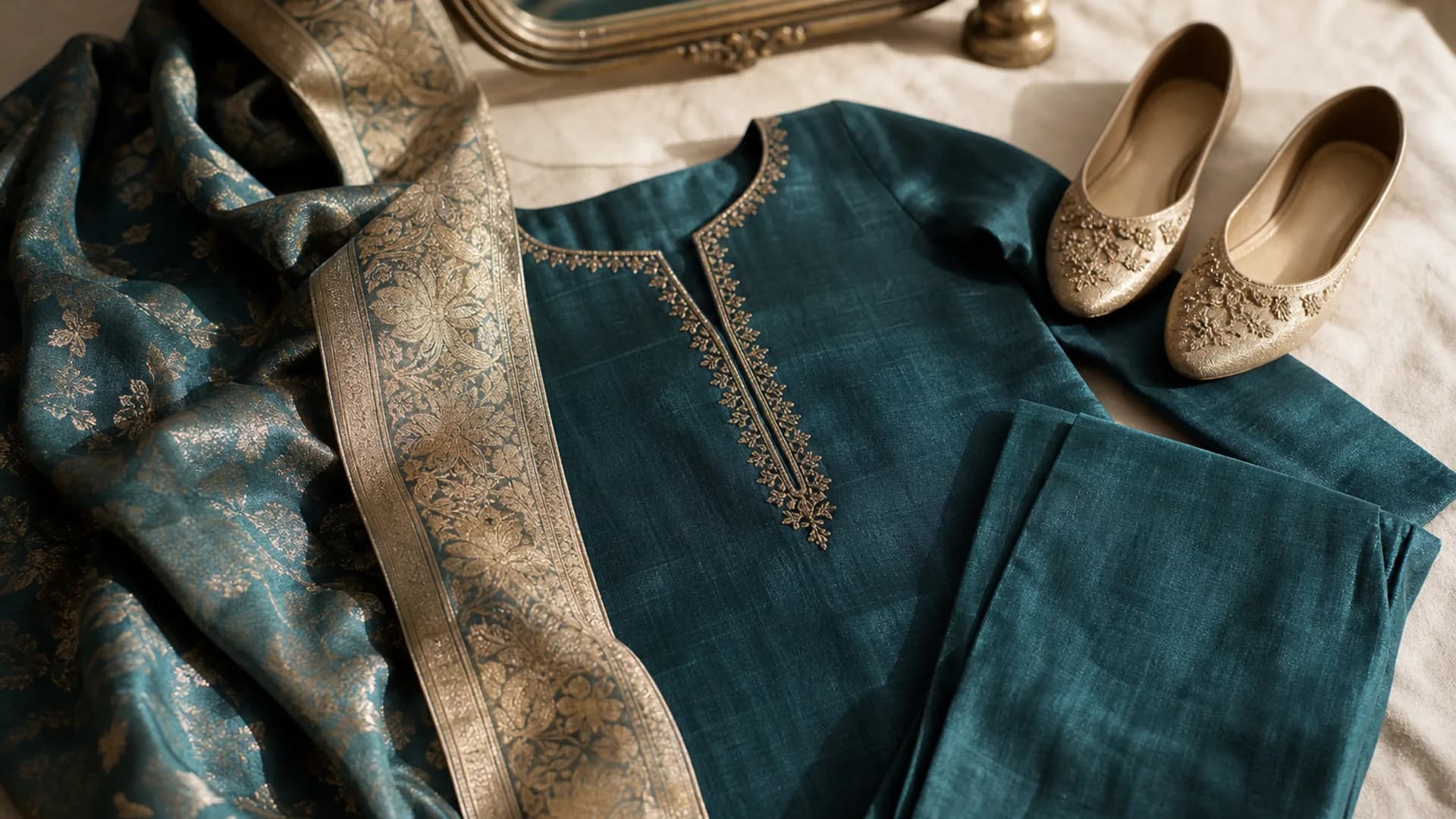
Formal Dressing in Your Forties and Fifties
There is a great deal of advice about what women over forty should stop wearing. Most of it is wrong. What actually changes is fit, fabric and comfort.
There is an enormous amount of advice about what women over forty should stop wearing. Most of it is either wrong or a matter of taste presented as a rule. Nothing becomes inappropriate at a birthday. Bright colours, fitted cuts, sleeveless, a sharara — none of these have an age limit, and the confident women wearing them at fifty look considerably better than the ones who followed the rules at thirty-five. What genuinely changes is more practical and less interesting than the rules suggest: your shape shifts, your priorities shift toward comfort, you attend different kinds of functions, and after twenty years of buying clothes you know a great deal more about what suits you than any guide can tell you. This is about those real changes, not about what to give up.
What Actually Changes
**Shape shifts, usually toward the middle.** Most women carry weight differently at fifty than at thirty, and the fit points that matter change with it — the waist and hip become more important, the bust less so. **Fabric matters more.** Skin becomes drier and more sensitive, and synthetics that were merely uncomfortable become genuinely irritating. Natural fibres stop being a preference. **Comfort stops being negotiable.** A tight waistband or a heavy outfit for a five-hour function is a different proposition at fifty than at twenty-five, and there is no reason to endure it. **The occasions change.** You are more often the host, the mother of the bride, or the senior family member — and those roles carry different expectations from being a guest. **Temperature regulation changes**, sometimes considerably. Layers you can remove become more useful than a single warm garment. None of these is about looking older. They are about what a garment has to do, and they point toward better fabric and better fit rather than toward covering up.
Fabric Is Where to Spend
This is the single biggest shift and the one that produces the most visible improvement. **Raw silk** is the most reliable formal fabric — it holds structure, drapes without clinging, photographs richly, and reads as expensive without needing embellishment. **Good crepe** for semi-formal and daywear. It skims rather than clings, which is exactly what is wanted, and it resists creasing across a long day. **Jamawar and brocade** give texture and presence without embroidery, which is a more sophisticated look than heavy work and considerably more comfortable. **Fine cotton and lawn** for everyday, in good quality rather than whatever is cheapest. **Velvet** for winter formals, where it is unmatched. **What to avoid:** polyester in any weight, stiff net, and anything with a hard synthetic shine. A flat synthetic sheen reads as cheap on anyone and is unkind under direct light. The underlying principle: **at this stage, one very good outfit beats three mediocre ones.** Our post on [telling real silk from fake](/journal/how-to-tell-real-silk-from-fake-pakistan) covers checking what you are buying, and the [fabric glossary](/content/fabric-glossary) explains the terms.
Cuts That Work
**A straight or A-line kameez in a good fabric.** The most reliable formal shape at any age and the one that always reads as considered. **An angrakha.** The diagonal wrap creates an unbroken line across the torso and the side tie is adjustable — genuinely useful if your shape has changed. Our [angrakha guide](/journal/angrakha-kameez-how-to-style-pakistan-2026) covers the fit points. **A long formal shirt with a churidar or straight trousers.** Traditional, elegant and always correct. **Wide-leg trousers and palazzos**, which have become the standard bottom and are considerably more comfortable than a fitted shalwar. **An empire line or long frock** for formal occasions, which is flattering without being fitted. **What to think about rather than avoid:** very fitted bodices and heavily structured corseted pieces, which are uncomfortable across a long function rather than inappropriate. And very short shirts with fitted trousers, which is a proportion that suits some frames and not others — a question of body rather than age. Our [fuller figure guide](/journal/fuller-figure-pakistani-formal-wear-guide) covers many of the same fit questions.
Colour: Ignore Most of the Advice
The instruction to move toward muted colours after forty is the least useful piece of advice in circulation. What actually happens is that skin tone shifts slightly — often cooler, sometimes with more visible redness — and hair changes, which changes what flatters. That is a reason to reassess, not a reason to go beige. **Jewel tones are excellent** on most mature skin tones — emerald, sapphire, plum, teal, deep rose. Rich rather than pale. **Deep neutrals** — chocolate, bronze, charcoal, stone — are more flattering than black for most people and considerably more interesting than beige. **Ivory and champagne** are more flattering than pure white, which is harsh against most skin at any age. **What to reassess:** very pale washed-out pastels, which can drain colour if your skin has cooled, and neon brights, which are unkind under direct light on anyone. Neither is a rule. **If your hair is grey or silver**, cool jewel tones and deep neutrals are exceptional against it, and warm yellows and oranges are harder. Our guide to [colours for Pakistani skin tones](/journal/best-colours-for-pakistani-skin-tones) covers testing this on yourself, and the [Virtual Try Room](/virtual-try-room) is a practical way to check before buying.
The Mother of the Bride or Groom
The specific occasion this question is most often asked about, and it has its own considerations. **You will be photographed more than anyone except the couple**, at every function, across several days. **Coordinate with the family palette but do not match the bridesmaids.** A shared colour family, a distinct shade. **Ask what the bride is wearing** for every function, not just the main one. **Formal but not competing.** Rich fabric, restrained embellishment. This is the occasion where jamawar or a good raw silk with a worked dupatta is a better choice than a heavily embroidered outfit. **Plan for comfort across a long day.** You will be standing, greeting, and on your feet for hours across several functions. Low block heels, a manageable dupatta, nothing that needs holding. **Plan all the functions together**, and repeat where guest lists differ. Our post on [planning a wedding wardrobe](/journal/how-many-outfits-pakistani-wedding-week-budget) covers the arithmetic. **Order early.** Alterations take time and this is not the outfit to rush. Our [tailor guide](/journal/working-with-a-tailor-darzi-guide) covers briefing properly.
Fit Is Where It All Shows
More than fabric, more than colour, fit is what separates a good outfit from an ordinary one — and it becomes more important, not less, as shape changes. **Re-measure yourself.** Most people are working from numbers that are years old. It takes five minutes and changes what you buy. **The shoulder decides everything.** A seam sitting past the point of your shoulder makes any garment read as too big. Buy for the shoulder and alter the body. Our post on [the five alterations that matter](/journal/five-alterations-make-any-suit-fit) covers what a tailor can fix. **Skimming, not clinging, and not tenting.** Clothing pulled tight reads as too small; clothing with no shape at all reads as larger. The middle is where it works. **Sleeve length matters.** Three-quarter is the most flattering on most arms, ending at the narrowest part of the forearm. **Have everything altered.** A ready-to-wear suit adjusted properly looks made; the same suit unaltered looks approximate. Our [size guide](/content/size-guide) has our measurements to compare against something you own.
Jewellery and Finishing
**One good piece beats several ordinary ones**, and this is the stage at which that becomes obviously true. **Real gold and pearls** rather than a large collection of artificial sets — though there is nothing wrong with artificial for a trend piece. Our post on [jewellery types](/journal/jewellery-explained-kundan-polki-gold-artificial) covers the distinctions. **Earrings are the highest-value spend.** They sit beside the face, they are in every photograph, and they show even when a dupatta covers everything else. **Skip the maang tikka and jhoomar** unless you are close family at a wedding — they read as bridal-adjacent. **Shoes: low block heels or elegant flats.** Comfort is not a compromise here, and a good flat looks better than an uncomfortable heel you keep shifting in. Our [shoes guide](/journal/shoes-with-pakistani-formal-wear-guide) covers the venue question. **A good dupatta transforms a plain outfit** and is the most efficient way to build a formal wardrobe from fewer pieces. Our [dupatta fabric guide](/journal/dupatta-fabric-guide-chiffon-organza-net-silk) covers which does what, and the [ladies collection](/ladies) shows the fabrics we work with.
Frequently Asked Questions
Nothing, on grounds of age. What genuinely changes is practical — your shape shifts, comfort matters more, skin becomes more sensitive to synthetics, and you attend different occasions. Those point toward better fabric and better fit, not toward covering up or going muted.
No. Jewel tones — emerald, sapphire, plum, teal — are excellent on most mature skin tones and better than the beige that gets recommended. What is worth reassessing is very pale washed-out pastels if your skin has cooled, and neon brights, which are unkind under direct light at any age.
Rich fabric with restrained embellishment — jamawar or good raw silk with a worked dupatta rather than heavy embroidery. Coordinate with the family palette without matching it, ask what the bride is wearing for each function, and plan for comfort across several long days on your feet.
Fit, and specifically the shoulder seam sitting on the point of your shoulder rather than past it. Most people are working from measurements that are years out of date. Re-measure, buy for the shoulder, and have everything altered — an altered ready-to-wear suit looks made.
Raw silk for formals, good crepe for semi-formal and daywear, jamawar or brocade when you want texture instead of embroidery, and velvet in winter. Avoid polyester in any weight — skin becomes more sensitive and a hard synthetic sheen is unkind under direct light.
About the Author
Habiba Minhas
Founder and creative director of Habiba Minhas, Pakistan's leading handcrafted fashion brand based in Karachi. With a passion for preserving traditional Pakistani craftsmanship while embracing modern design, she has built a brand serving over 5,000 customers nationwide.
Specializing in premium ladies suits, kids festive wear, and baby products, Habiba works directly with artisan embroiderers and skilled tailors to create pieces that honor Pakistani heritage.
Related Articles
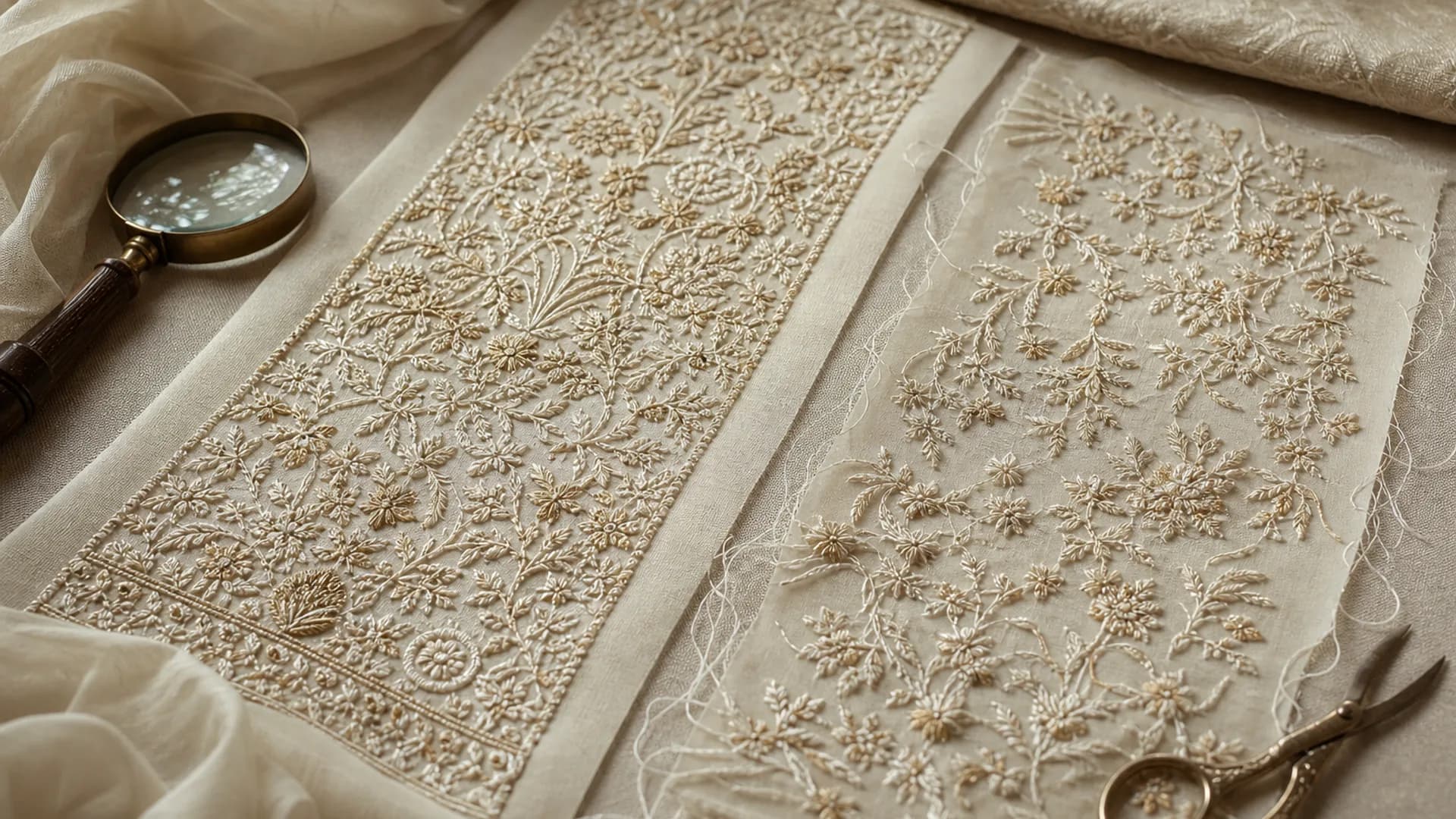
Original or Copy: How to Tell a Replica Suit
Master copies are sold openly and often honestly. The problem is when a copy is sold as an original at an original's price — here is how to tell.
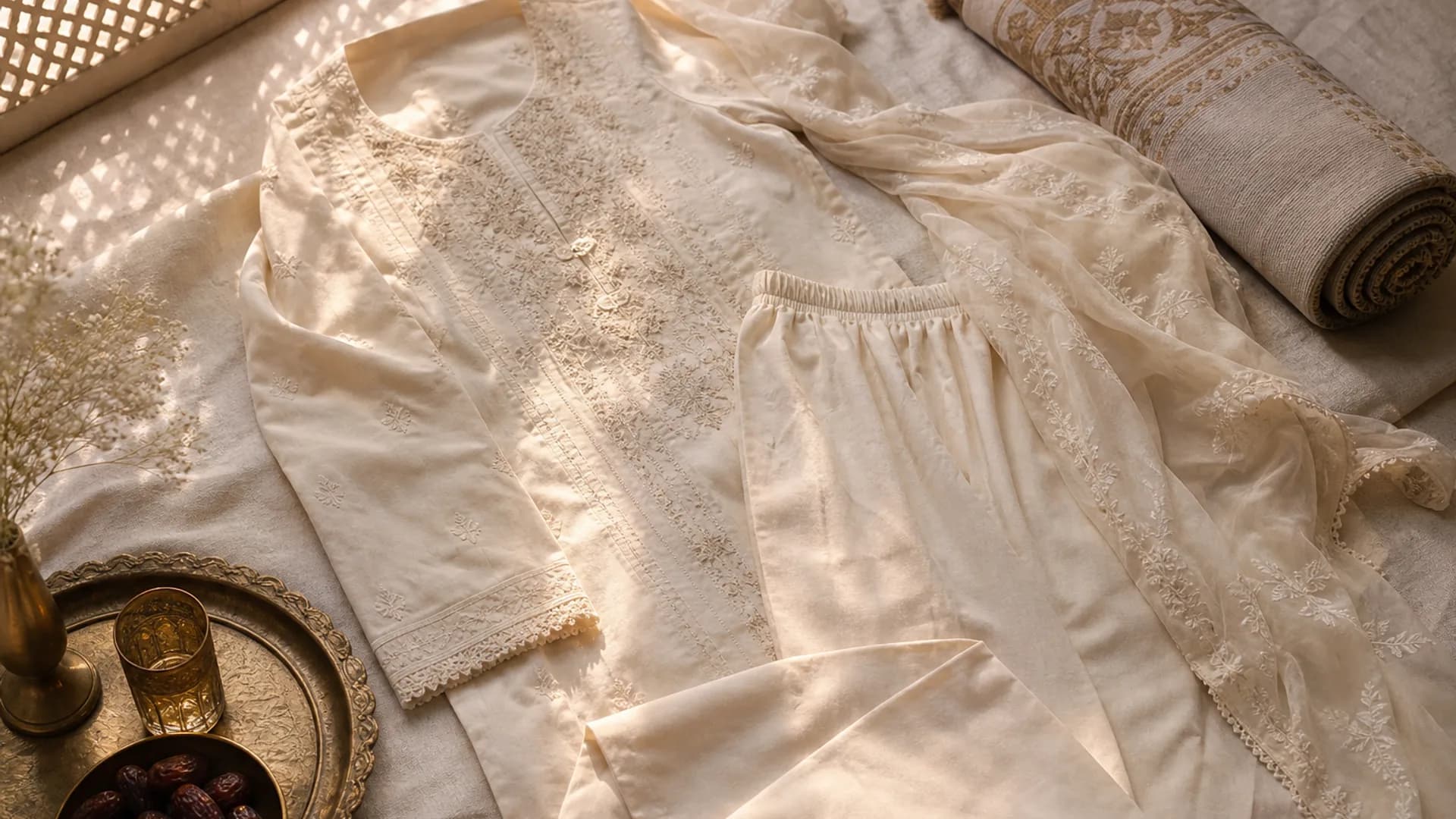
Dressing for Ramadan and Iftar Gatherings
Ramadan runs a month, and the clothing has to work for fasting through the afternoon and hosting in the evening. The two are different problems.
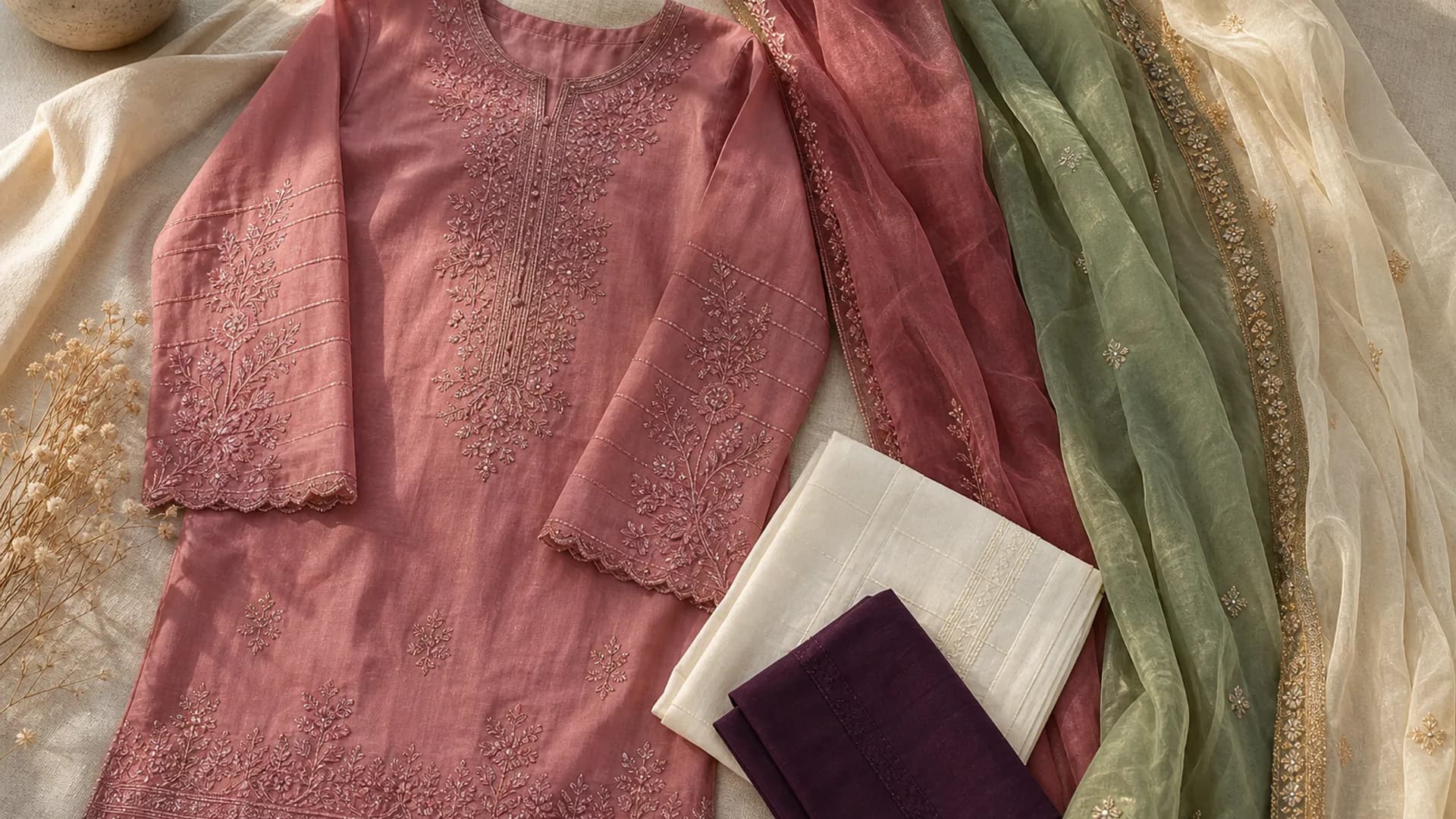
Matching a Dupatta or Trouser to a Shirt
Almost matching looks worse than clearly not matching. Here is how to pair pieces bought separately so the outfit reads as deliberate.