

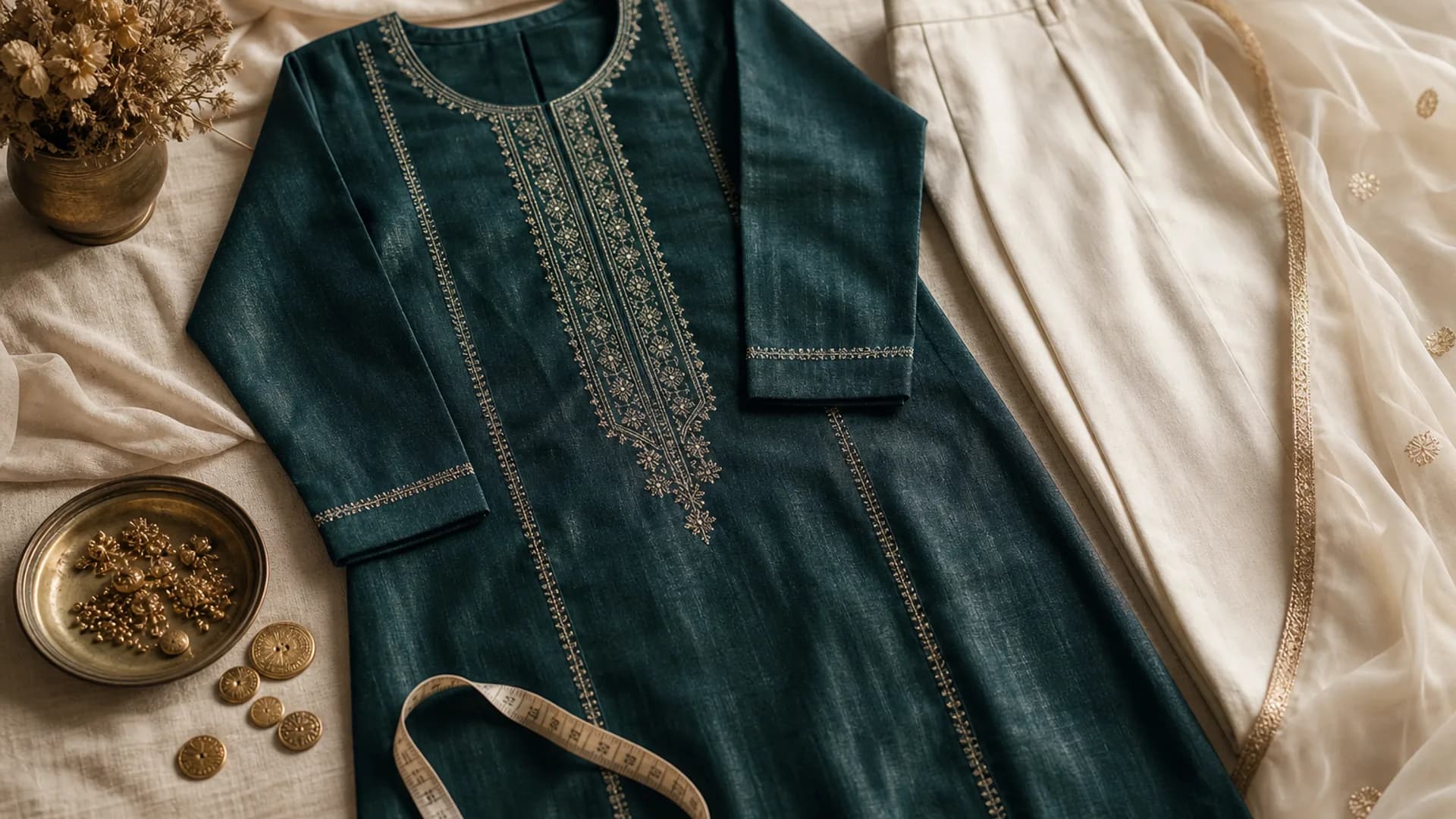
Dressing a Fuller Figure in Pakistani Formals
The standard advice is to hide everything under loose fabric, which is exactly what makes an outfit look shapeless. Here is what genuinely works.
The advice given to fuller-figured women is nearly always the same: go loose, go dark, go long, cover everything. Followed properly, that produces an outfit with no shape at all — and a garment with no shape does not read as slimmer, it reads as larger, because the eye has nothing to measure against except the widest point. What actually works is structure in the right places and looseness in the others. A defined shoulder, a skimming rather than clinging body, and volume that starts below the widest point of the hip. That is a genuinely different instruction from covering up, and it produces a genuinely different result. This is what to look for, and what to ask a tailor for.
The Cuts That Work
**The A-line kameez.** Fitted through the shoulder and bust, then flaring gently from below the bust or the waist. It skims the hip and stomach without touching either, and it is the most reliable formal shape available. If you buy one thing, buy this. **The anarkali or long frock.** Fitted to just under the bust, then full. Dramatic, formal, and it removes the waist from the conversation entirely. Excellent for weddings, less useful for everyday. **The angrakha.** The diagonal wrap creates an unbroken line across the torso instead of a horizontal waist seam, and the side tie is adjustable rather than fixed. Our [angrakha guide](/journal/angrakha-kameez-how-to-style-pakistan-2026) covers the fit points to check. **A straight-cut long shirt with a defined shoulder.** Simple, formal, and works when the shoulder seam is right. **What to avoid:** a completely straight, boxy kameez with a dropped shoulder. It is the most common ready-to-wear cut and the least flattering — no definition anywhere, so the whole body reads as one width.
The Shoulder Seam Decides Everything
This is the measurement worth caring about more than any other, and it is the one nobody checks. The shoulder seam should sit on the corner of your shoulder — the bony point — not beyond it. When it hangs off, the whole garment drops with it, the armhole sinks, and the outfit reads as too big rather than as fitting a fuller frame. The cruel part is that ready-to-wear scales the shoulder up with the bust, so a larger size often gives you a wider shoulder you did not need. Buying up to fit the bust is how most people end up in a shirt with a dropped shoulder. The better order: buy for the shoulder, then have the body let out or taken in. A shoulder cannot be narrowed cheaply on a finished garment with a set sleeve, but a side seam is a ten-minute job. Our guide on [picking a size in ready-to-wear](/journal/how-to-pick-size-pakistani-ready-to-wear) covers judging this before you buy, and the [size guide](/content/size-guide) has our measurements to compare against something you own.
Fabric: Weight and Drape Over Everything
Fabric matters more here than for any other body type, because a fuller frame shows the difference between a fabric that skims and one that clings. **Georgette, crepe and good chiffon** are the best all-round choices. They have enough weight to fall straight down rather than following every curve, and they move well. **Raw silk** works and is the most formal option — it holds a structured shape and does not cling at all. **Jamawar and brocade** give texture and structure, though they add visual bulk, so keep the cut clean if the fabric is busy. **What to avoid:** thin clingy synthetics, stiff net, and anything with a strong sheen across the whole garment. A high-shine surface highlights every contour it passes over, which is why a matte or lightly textured finish is more forgiving than a glossy one. One practical note: **lining is not optional.** An unlined georgette clings in exactly the way you were hoping to avoid, and a good lining changes the fall of the whole garment. Our [fabric glossary](/content/fabric-glossary) explains the names, and our guide on [telling real silk from fake](/journal/how-to-tell-real-silk-from-fake-pakistan) covers checking what you are actually buying.
Necklines and Sleeves
**Necklines.** A V-neck or a deep scoop is the strongest choice — the vertical line breaks up the chest area and lengthens the neck, which is where a fuller figure benefits most. A narrow square neck is the next best. Avoid a high round neck, which shortens the neck and widens the chest, and avoid a very wide boat neck. Our [neckline guide](/journal/kameez-neckline-guide-which-suits-you) goes through the whole set. **Sleeves.** Three-quarter is the most flattering length — it ends at the narrowest part of the forearm and creates a natural break. Full sleeves work well too. The length to avoid is the elbow-length sleeve, which stops at the widest part of the upper arm. **Sleeve fit.** Not tight. A sleeve that grips the upper arm creates a visible line through the fabric and is the single most common fit complaint. A gently tapered sleeve with a little ease is more comfortable and looks considerably better. **Armhole depth.** A deep, roomy armhole is more comfortable but reads as bulky. A properly cut armhole sitting close to the underarm is what makes a garment look tailored.
Trousers and Where Volume Goes
The principle is that volume should start below the widest point, never at it. **Straight-cut trousers** are the safest and most flattering — they fall clean from the hip with no gathering. **Palazzos** work well and are the most comfortable, provided the waistband is flat-fronted rather than gathered. Gathering at the waist adds bulk exactly where you do not want it. **A sharara** works if the flare starts at the thigh rather than the hip, and if the waist is flat. **A shalwar with heavy pleating at the waist** is the shape to avoid. All that fabric gathered at the widest point adds width and nothing else. Our guide to [sharara, gharara and palazzo](/journal/sharara-vs-gharara-vs-palazzo-difference) covers telling the cuts apart. **Churidars** are less forgiving and are worth trying rather than ordering blind — the fitted leg suits some fuller figures very well and others not at all, depending on where you carry weight.
Colour, Print and Placement
Dark colours are slimming, which is true and also boring, and it is not the only tool available. **A tonal outfit in any colour** does more than a dark one in a contrasting combination. Kameez, trouser and dupatta in one colour family reads as a single column with no interruption. Ivory works as well as navy. **Vertical placement beats overall coverage.** A worked centre panel down the front of a kameez, vertical embroidery, or a front placket all pull the eye up and down. All-over embroidery across the body does the opposite. **Keep heavy work above the bust or below the knee**, not across the middle. A border at the hem and work at the neckline is a good pair; a worked waistband is not. **Print scale:** medium, spaced motifs. Very small dense repeats read as texture and flatten the whole shape; very large single motifs placed across the widest point draw attention to it. Our guide to [colours for Pakistani skin tones](/journal/best-colours-for-pakistani-skin-tones) covers choosing within that, and the [colour trends post](/journal/pakistani-fashion-colour-trends-2026) has this year's palette.
The Dupatta, Used Properly
A dupatta is the most useful styling tool available for a fuller figure and the most commonly wasted one. **Over one shoulder, hanging long down the front.** This creates a vertical line down one side of the body and visually narrows the whole torso. It is the single best drape and costs nothing. **Pinned at the shoulder** so it stays where you put it. An unpinned dupatta that slips and spreads across the chest does the opposite of what you want. **Avoid draping across both shoulders with both ends hanging** — it creates a wide horizontal band across the widest part of the upper body. **Fabric matters.** A stiff net dupatta stands away from the body and adds width. A soft chiffon or silk falls close and adds a vertical line. Our [dupatta draping guide](/journal/7-ways-drape-dupatta-weddings-formal-events) has the full set of styles, several of which are specifically useful here.
Buying Online Without Guessing
Sizing across Pakistani brands is genuinely inconsistent at the larger end, and the fix is to stop trusting the label. **Measure a garment you already own and like.** Lay it flat and measure chest, waist, hip, shoulder seam to seam, sleeve length and total length. Those six numbers are worth keeping in your phone. **Compare against the seller's flat measurements, not their size chart.** A chart is a size claim; a flat measurement is a fact. **Ask for the shoulder measurement specifically.** Most sellers list chest and length and omit the one that matters. **Order to fit the largest measurement and plan to alter.** Taking in is cheap, letting out is limited by the seam allowance, and the shoulder cannot be fixed at all. **Check the returns terms before ordering**, particularly for stitched pieces. Ours are on the [returns page](/help/returns). And if you want to see how a cut sits on you before committing, the [Virtual Try Room](/virtual-try-room) is worth using. The [stitched suits](/ladies/stitched-suits) and the wider [ladies collection](/ladies) are where to start.
Frequently Asked Questions
An A-line — fitted through the shoulder and bust, then flaring gently from below the bust or waist so it skims the hip and stomach without touching either. An anarkali works for formal occasions. Avoid a boxy straight cut with a dropped shoulder, which gives the body no definition at all.
No. A tonal outfit in one colour family — kameez, trouser and dupatta in close shades — does more than a dark outfit in contrasting colours, because it reads as one unbroken column. Ivory head to toe works as well as navy. Vertical placement of embroidery matters more than the shade.
Three-quarter, which ends at the narrowest part of the forearm, or full length. Avoid an elbow-length sleeve, which stops at the widest part of the upper arm. Whatever the length, the sleeve should have a little ease rather than gripping the arm.
Because ready-to-wear scales the shoulder up along with the bust, so a larger size gives you a wider shoulder you did not need. The seam then hangs off the shoulder point and the whole garment drops. Buy for the shoulder and have the body altered — a side seam is easy, a shoulder is not.
Over one shoulder, hanging long down the front, and pinned so it stays put. That creates a vertical line down one side and narrows the torso visually. Avoid draping across both shoulders with both ends hanging, which puts a wide horizontal band across the upper body.
About the Author
Habiba Minhas
Founder and creative director of Habiba Minhas, Pakistan's leading handcrafted fashion brand based in Karachi. With a passion for preserving traditional Pakistani craftsmanship while embracing modern design, she has built a brand serving over 5,000 customers nationwide.
Specializing in premium ladies suits, kids festive wear, and baby products, Habiba works directly with artisan embroiderers and skilled tailors to create pieces that honor Pakistani heritage.
Related Articles
Eight Ways to Restyle a Formal Suit You Own
Most wardrobes hold three or four formal outfits that have been worn once and feel finished. Very little needs to change to make them wearable again.
Formal Dressing in Your Forties and Fifties
There is a great deal of advice about what women over forty should stop wearing. Most of it is wrong. What actually changes is fit, fabric and comfort.
Original or Copy: How to Tell a Replica Suit
Master copies are sold openly and often honestly. The problem is when a copy is sold as an original at an original's price — here is how to tell.