

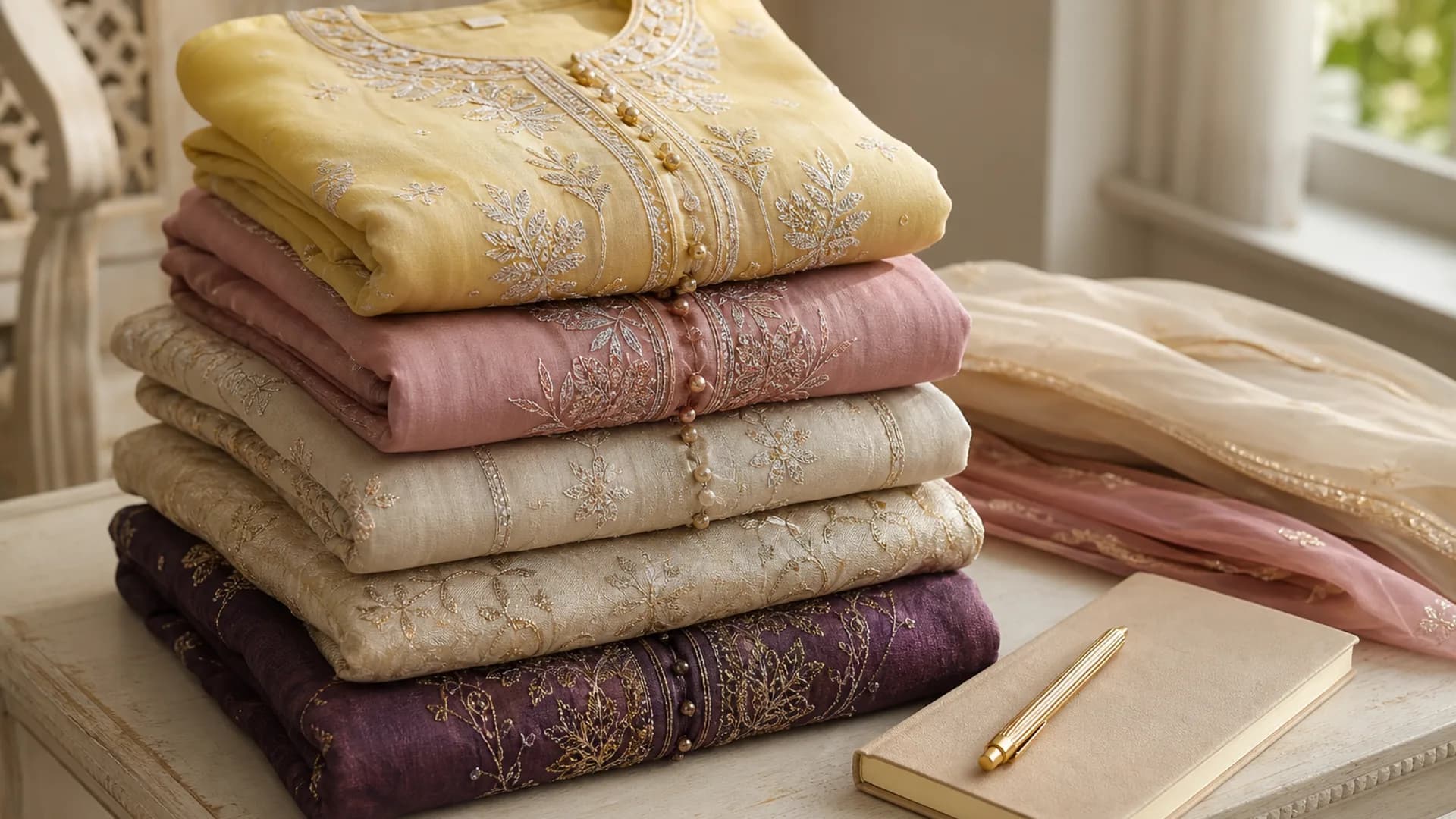
How Many Outfits Do You Need for a Shaadi?
Five functions does not mean five outfits. Here is how to plan a wedding wardrobe that covers the week without buying five things you will never wear again.
A full Pakistani wedding can run to five functions across a week or more: dholki, mehndi, nikah, barat and walima. Sometimes a mayoun and a qawwali night as well. The assumption is that this means five outfits. For close family it often does. For most guests it does not, and treating it as five separate purchases is how a wedding season becomes genuinely expensive for people who are attending rather than hosting. What actually matters is how many *different people* see you across the functions, and how far apart on the formality scale those functions sit. Once you look at it that way, five functions usually resolves into two or three outfits and a set of changes. This is how to plan it.
First, Work Out Which Functions You Are Attending
Very few guests attend everything, and the invitation usually tells you. **General guests** are typically invited to the barat and walima, sometimes the mehndi. That is two or three functions, often on different days with substantially different guest lists. **Friends of the couple** get the mehndi and dholki as well, which are the informal end. **Extended family** attend nearly everything. **Close family** attend everything and are photographed at all of it. The distinction matters because guest lists overlap much less than people assume. The dholki crowd and the walima crowd are frequently different sets of people, which means an outfit can be reused across them without anyone noticing. Write down which functions you are actually going to before buying anything. Most people plan for a wedding they are not fully attending.
The Formality Ladder
The five functions are not five levels. They cluster into three. **Informal:** dholki and mayoun. Home or small hall, bright colours, cotton and lawn, minimal work. Comfort matters because you will be on the floor. **Semi-formal to festive:** mehndi. Bright, festive, sharara or a worked kurta, still comfortable enough to dance in. Our [mehndi guide](/journal/what-to-wear-mehndi-night-pakistan) covers the specifics. **Formal:** nikah, barat and walima. Silk, embroidery, full three-piece or sharara sets. The nikah is the most restrained of the three — our [nikah guide](/journal/nikah-outfit-guide-guests-pakistan) covers why — and the barat and walima are the heaviest. That means a guest attending everything needs roughly three levels of outfit, not five. And two of the three formal functions can share an outfit if the guest lists differ, or if you change the dupatta and jewellery. Our [formal wear guide](/journal/pakistani-formal-wear-guide-party-semi-formal-festive) sets out the ladder in full.
The Realistic Numbers
**A guest attending two functions:** two outfits. One formal, one semi-formal. Neither needs to be new if you already own something suitable. **A guest attending three or four:** two outfits and one strong reuse. Wear the formal one at the barat, the semi-formal at the mehndi, and repeat the formal at the walima with a different dupatta and different jewellery. **Extended family attending everything:** three outfits. One informal, one festive, one formal — with the formal repeated once. **Close family:** four to five, and there is not much way around it. You are in every photograph and beside the couple at most of them. But even here, the dholki outfit can be something you already own. The number that surprises people: **one genuinely good formal outfit plus one festive outfit covers a whole wedding for the majority of guests.** The rest is variation.
Where the Budget Should Go
If the total is fixed, the allocation matters more than the total. **Spend the largest share on the formal outfit.** It is worn at the most photographed function, it is the one that can be repeated at other weddings for years, and it is where fabric quality is most visible. **Spend on fabric, not embellishment.** Heavy work dates quickly and is instantly recognisable in a photograph — which is precisely what stops you wearing it again. A good silk in a well-chosen colour is not recognisable and does not date. Our post on [telling real silk from fake](/journal/how-to-tell-real-silk-from-fake-pakistan) covers checking what you are paying for. **Spend on the dupatta.** A worked dupatta over a plain shirt gives you a second outfit for free, because swapping it changes the whole look. Our [dupatta fabric guide](/journal/dupatta-fabric-guide-chiffon-organza-net-silk) covers which fabric does what. **Do not spend much on the informal outfit.** A good cotton or lawn kurta you already own is correct for a dholki, and buying something new for it is the least efficient money in the whole plan. **Buy one good pair of metallic shoes**, not four pairs matched to four outfits. Our [shoes guide](/journal/shoes-with-pakistani-formal-wear-guide) covers why.
Repeating Without It Being Obvious
Repeating a formal outfit inside one wedding is entirely normal and almost nobody notices, provided three things change. **The dupatta.** The largest visual element and the easiest to swap. A plain silk dupatta at the nikah and an organza one with a worked border at the walima produce two different outfits from the same shirt and trouser. **The jewellery.** Pearls at one function and gold at the next changes the whole register. **The hair.** Down at one, up at the other. This does more than people expect in photographs. What does not disguise a repeat: different shoes and a different bag. Nobody was looking at those. The one situation to avoid repeating: two functions on consecutive days with the same guests and a photographer at both. Otherwise it is not worth worrying about. Our [capsule wardrobe guide](/journal/capsule-wardrobe-pakistani-women-10-pieces) applies the same logic across a whole season rather than one week.
Planning the Colours Together
This is the step people skip, and it produces the most common regret — three outfits in three shades of the same pink. Choose the palette for the whole week at once, before buying anything. **Vary the depth, not just the hue.** A pale outfit, a mid-tone and a deep one photograph as three distinct looks even if all three are in related colours. **Check what the family is wearing.** If close family have agreed a palette for a function, a guest in the same shade sits oddly in group photographs, and family members should be coordinating rather than matching. **Check what the bride is wearing** for each function. Red at the barat is hers. Whatever she has chosen for the mehndi and walima is worth knowing. **Account for the lighting.** A daytime nikah and a midnight barat under warm string lights need different colours — pale cool tones go grey under warm light. Our [winter wedding guide](/journal/winter-wedding-guest-outfit-guide-pakistan) covers this, and the [colour trends post](/journal/pakistani-fashion-colour-trends-2026) has the year's palette.
A Worked Example
A guest invited to the mehndi, barat and walima, wanting to spend sensibly: **Mehndi.** A bright sharara or worked kurta in chiffon — yellow, orange or fuchsia. Mid-range spend. This piece also works for Eid and for other people's mehndis for years. **Barat.** The main purchase. A worked three-piece in raw silk, in a jewel tone or a rich neutral. This is where the budget goes. **Walima.** The barat outfit again, with a different dupatta, different jewellery and different hair. Or, if the guest lists overlap heavily, something already in the wardrobe. That is two purchases covering three functions, with both pieces genuinely wearable afterwards. Compare it with three new outfits, one of which — the walima piece — is typically the most expensive, the most heavily worked, and the least likely to be worn again. The difference is not small. You can see the formal end of this across our [3-piece suits](/ladies/3-piece-suits) and the [party wear](/ladies/party-wear) section, and the [Virtual Try Room](/virtual-try-room) will show you how a colour sits on you before you commit to the main purchase.
Frequently Asked Questions
Usually two — one formal and one semi-formal — covering three or four functions, with the formal repeated once. Guest lists between functions overlap far less than people assume, so the same outfit at the barat and walima is rarely noticed if the dupatta and jewellery change.
Yes, and it is common. Change the dupatta, the jewellery and the hair and it reads as a different outfit in photographs. The only case worth avoiding is two functions on consecutive days with the same guests and a photographer at both.
On the formal outfit for the barat or walima, and within that on fabric rather than embellishment. Heavy work is recognisable and dates quickly, which is what stops you wearing it again. A good silk in a well-chosen colour stays wearable for years.
No. A dholki is the most informal function of the week — a good cotton or lawn kurta you already own is correct, and heavy embroidery reads as overdressed there. Buying something new for the dholki is the least efficient part of a wedding wardrobe.
Choose the whole week's palette before buying anything, and vary the depth as well as the hue — a pale, a mid-tone and a deep outfit read as three distinct looks. Check what the bride is wearing for each function, and what close family have agreed for group photographs.
About the Author
Habiba Minhas
Founder and creative director of Habiba Minhas, Pakistan's leading handcrafted fashion brand based in Karachi. With a passion for preserving traditional Pakistani craftsmanship while embracing modern design, she has built a brand serving over 5,000 customers nationwide.
Specializing in premium ladies suits, kids festive wear, and baby products, Habiba works directly with artisan embroiderers and skilled tailors to create pieces that honor Pakistani heritage.
Related Articles
Eight Ways to Restyle a Formal Suit You Own
Most wardrobes hold three or four formal outfits that have been worn once and feel finished. Very little needs to change to make them wearable again.
Formal Dressing in Your Forties and Fifties
There is a great deal of advice about what women over forty should stop wearing. Most of it is wrong. What actually changes is fit, fabric and comfort.
Original or Copy: How to Tell a Replica Suit
Master copies are sold openly and often honestly. The problem is when a copy is sold as an original at an original's price — here is how to tell.