

Petite Styling: How to Look Taller in a Suit
Most petite styling advice is about heels. The things that actually change how tall you look are shirt length, where the flare starts, and how you drape a dupatta.
Most advice for shorter women stops at heels, and heels are the least useful thing on the list. They add two or three inches for an evening; the rest of the outfit either works with your proportions or fights them, all day, in every photograph. What actually decides whether a suit reads as long or short on a petite frame is proportion — where the shirt ends, where the trouser starts to widen, how many horizontal lines cross the body, and where the eye is asked to stop. None of that requires buying different clothes. It requires knowing which of the shapes already on the rail will work, and asking a tailor for two or three specific measurements instead of accepting the standard cut.
Shirt Length Is the Single Biggest Lever
This is the measurement that decides everything else, and standard ready-to-wear gets it wrong for petite frames more often than any other. A kameez cut for someone five foot six lands mid-calf on someone five foot two. It is not that it looks long — it is that it divides the body low, leaving a short stub of trouser below and a very long block above, which reads as squat rather than tall. The rule that works: the shirt should end above the widest point of your thigh, or below the knee — not in between. Mid-thigh to just-above-knee is the dead zone for a short frame. For most petite women a shirt ending at mid-thigh, with the hemline sitting at or just above where the fingertips fall, gives the best proportion. That is roughly two to four inches shorter than a standard cut. This is a five-minute alteration on almost any suit, and it is the alteration worth making every time. Ask for it when you buy rather than intending to get it done later.
Where the Trouser Widens
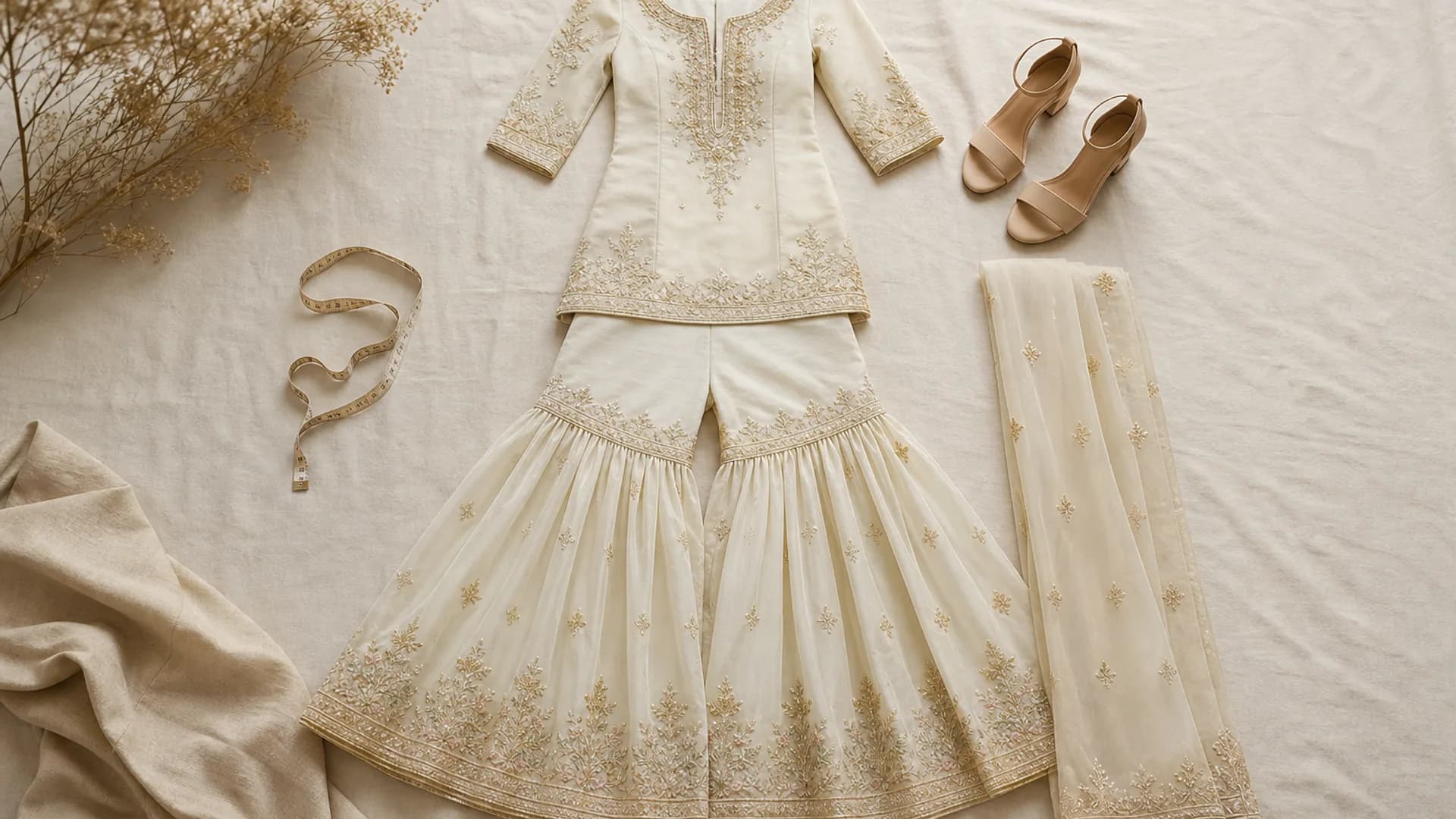
Volume below the waist is not the enemy. Volume starting low down is. **A high-waisted sharara works beautifully** on a short frame, because the flare begins high and the leg reads as starting at the waist rather than the hip. Combined with a short kurti, this is the single most flattering formal combination for petite women, and it is the opposite of what most people expect. **A gharara does not.** The horizontal knee joint cuts the leg exactly in half at the worst possible point. If you love ghararas, choose one with the joint sitting higher than usual and accept it will be a compromise. **A churidar is excellent.** The gathers at the ankle create vertical texture and the narrow leg keeps the line unbroken. **A palazzo works** if the length is right — and this is the failure point. A palazzo dragging on the floor removes several inches visually. It should just clear the ground in the shoes you will wear. **A wide shalwar with a low crotch** is the shape to avoid. It shortens the leg and adds width at the hip simultaneously. Our guide to [sharara, gharara and palazzo](/journal/sharara-vs-gharara-vs-palazzo-difference) explains how to tell them apart when a shop uses the names loosely.
Count the Horizontal Lines
Every horizontal line across the body is a place the eye stops. Each stop shortens the frame. On a typical formal outfit those lines are: an embroidered hem border, a waist seam or belt, a contrast panel, a knee joint, an ankle cuff, and a dupatta draped across the chest. Six stops on one outfit is common and it is far too many for a short frame. Aim for two, and make them count. A worked neckline near the face and a hem border is a good pair. A worked neckline, a waist detail, a contrast panel and a heavy hem is not. The corollary is that vertical detail helps. A worked centre panel down the front of a kameez, vertical embroidery on a sleeve, or a front placket all pull the eye up and down instead of across. This is also why an angrakha suits petite frames so well — the diagonal wrap replaces a horizontal line with an angled one, which does not stop the eye the same way. Our [angrakha guide](/journal/angrakha-kameez-how-to-style-pakistan-2026) covers the cut in detail.
Colour and the Tonal Column
The most effective single change is to wear one colour family from shoulder to floor. A tonal outfit — kameez, trouser and dupatta in the same shade or in close shades of it — reads as one continuous column. There is no point where the eye is told the body ends and the legs begin. This does more for apparent height than anything else on this list. It does not have to be dark. Ivory head to toe works exactly as well as navy head to toe, and in Pakistani formal wear a tonal ivory or champagne outfit is genuinely elegant rather than plain. What breaks the column: a strongly contrasting trouser, a contrasting dupatta worn across the chest, and a contrast border at the hem in a much darker shade. If you want contrast, put it near your face — a contrast dupatta draped over one shoulder, or contrast work at the neckline. Contrast high pulls the eye up; contrast at the hem drags it down. Our guide to [colours for Pakistani skin tones](/journal/best-colours-for-pakistani-skin-tones) covers which shades suit you within that.
Print and Embroidery Scale
Scale is the thing petite women are most often given wrong advice about. The usual instruction is to avoid large prints entirely, which is not quite right. What overwhelms a small frame is a *dense* print — many motifs, repeated closely, over the whole garment. It reads as busy and there is no plain fabric left to give the eye a rest. A single large motif, placed well, is fine and often better than a small all-over print. A large border on a dupatta is fine. Placed embroidery on one panel is fine. What to avoid: all-over small floral repeats across a full-length shirt, heavy work covering the entire body of the kameez, and wide contrasting borders at every edge. The practical version: hold the fabric up in front of you at arm's length. If the pattern reads as texture rather than as individual motifs, it will overwhelm you. If you can see each motif clearly and there is space between them, it will not.
The Dupatta, Which Undoes Everything
A dupatta draped straight across the chest and hanging on both sides creates the widest, most shortening horizontal line in the entire outfit — and it is the standard drape. Better options for a short frame: **One shoulder, hanging long.** A single vertical fall down one side. The most lengthening drape there is. **Pinned at the shoulder, falling down the back.** Keeps the front of the outfit clean and the column unbroken. **Narrow rather than wide.** A very wide dupatta swamps a small frame. If yours is wide, fold it lengthways before draping rather than letting it spread. **Skip the across-both-shoulders drape** unless you are covering your head, in which case pull one end long down the front rather than letting both hang at the same length. Length matters too — a dupatta that falls to mid-calf on you was cut for someone taller and can be shortened. Our [dupatta draping guide](/journal/7-ways-drape-dupatta-weddings-formal-events) has the full set of styles.
What to Ask a Tailor
Three measurements change a standard suit into one cut for you, and none of them cost much. **Shirt length.** Give a number in inches from the shoulder, not a description. Measure a shirt you already own and like, and use that. **Trouser length.** Measured in the shoes you will actually wear. This is the one people get wrong, and a dragging hem cancels out everything else. **Sleeve length.** A sleeve that hangs past the wrist bone makes arms — and by extension the whole frame — look shorter. It should end at the wrist bone or just above. One more worth asking for: **narrow the shoulder seam** if it hangs off. A dropped shoulder on a small frame widens the top and shortens the neck, and it is the most common ready-to-wear fit problem for petite women. Our guide on [picking a size in ready-to-wear](/journal/how-to-pick-size-pakistani-ready-to-wear) covers judging fit before you buy, and the [size guide](/content/size-guide) has our measurements so you can compare against something you own. If you want to see how a shape sits on you before ordering, the [Virtual Try Room](/virtual-try-room) will show you, and the [3-piece suits](/ladies/3-piece-suits) are where to start looking.
Frequently Asked Questions
Above the widest point of the thigh, or below the knee — never in between. For most petite women that means mid-thigh, with the hem around where the fingertips fall, which is two to four inches shorter than a standard ready-to-wear cut. It is a quick alteration and worth doing every time.
Yes, and better than most shapes. A high-waisted sharara with a short kurti starts the flare high so the leg reads as beginning at the waist, giving one long unbroken line. A gharara does the opposite — its knee joint cuts the leg horizontally at the worst possible point.
Over one shoulder, hanging long, or pinned at the shoulder and falling down the back. The standard drape straight across the chest with both ends hanging creates a wide horizontal line, which is the most shortening thing in the outfit. Fold a wide dupatta lengthways before draping.
Not large prints — dense ones. A single well-placed large motif or a bold dupatta border is fine. What overwhelms a small frame is a small all-over repeat covering the whole garment, which reads as texture rather than pattern and leaves the eye nowhere to rest.
Wear one colour family from shoulder to floor. A tonal outfit reads as a single unbroken column with no point where the eye is told the legs begin. It works in ivory just as well as in navy, and it does more for apparent height than heels do.
About the Author
Habiba Minhas
Founder and creative director of Habiba Minhas, Pakistan's leading handcrafted fashion brand based in Karachi. With a passion for preserving traditional Pakistani craftsmanship while embracing modern design, she has built a brand serving over 5,000 customers nationwide.
Specializing in premium ladies suits, kids festive wear, and baby products, Habiba works directly with artisan embroiderers and skilled tailors to create pieces that honor Pakistani heritage.
Related Articles
Eight Ways to Restyle a Formal Suit You Own
Most wardrobes hold three or four formal outfits that have been worn once and feel finished. Very little needs to change to make them wearable again.
Formal Dressing in Your Forties and Fifties
There is a great deal of advice about what women over forty should stop wearing. Most of it is wrong. What actually changes is fit, fabric and comfort.
Original or Copy: How to Tell a Replica Suit
Master copies are sold openly and often honestly. The problem is when a copy is sold as an original at an original's price — here is how to tell.