

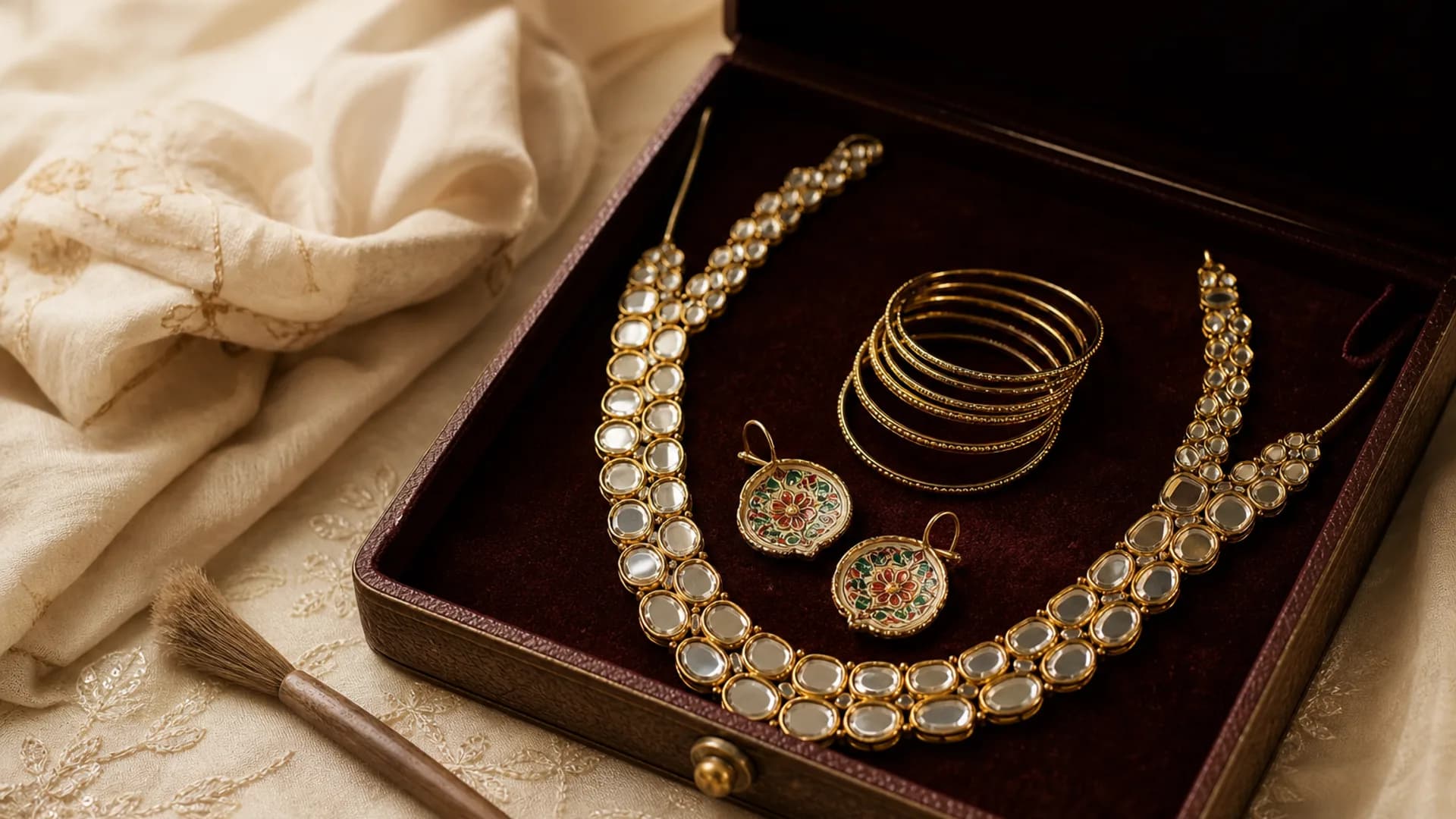
Kundan, Polki, Jadau: Jewellery Terms Explained
Four words appear on every jewellery listing and almost nobody knows what they mean. Two are stones, one is a technique, and the price difference is enormous.
Every jewellery listing uses the same four words — kundan, polki, jadau, meenakari — and they are used almost interchangeably by sellers who assume you know the difference. Most buyers do not, and the price range between them is enormous. A kundan set and a polki set can look nearly identical in a photograph and differ by a factor of twenty in price, because one uses glass and the other uses uncut diamonds. The distinction that clears most of the confusion up front: **kundan and polki are stones. Jadau is a technique. Meenakari is decoration on the back.** They are not four alternatives; they describe different aspects of the same piece, and one necklace can be all four at once. Here is what each one is, and when it is worth paying for.
Kundan: Glass Set in Gold
Kundan refers to a technique of setting stones using highly refined gold, and in common use it has come to mean the jewellery made with glass stones set that way. **What it is:** flat, polished glass stones held in place by thin strips of pure gold foil pressed around the edges. No prongs, no glue — the gold itself grips the stone. **How it looks:** flat, bright and reflective, with a clean white or coloured sparkle. The setting shows as a smooth gold rim around each stone. **The cost:** the glass is inexpensive; the gold and the labour are not. Real kundan in solid gold is still a substantial purchase. Kundan-style pieces in gold-plated brass are affordable, and are what most people actually buy. **When it is right:** most formal occasions. It photographs beautifully, it is lighter than polki, and it comes in every colour because the glass can be tinted. The important point for buyers: **kundan is not a lesser version of polki.** It is a different material with its own long tradition, and a well-made kundan set looks superb.
Polki: Uncut Diamonds
Polki is the expensive one, and the difference is genuine. **What it is:** natural diamonds in their raw, uncut state — mined and cleaved but not faceted or polished the way a modern diamond is. Set in gold using the same technique as kundan. **How it looks:** subtler and warmer than kundan. Because the surface is not faceted, polki does not flash the way a cut diamond does — it has a soft, glowing, slightly milky lustre. Many people find it more beautiful precisely because it is quieter. **The cost:** substantially more than kundan, because the stones are diamonds. A polki set is a significant investment and is generally treated as an heirloom rather than a purchase. **How to tell them apart:** polki has a warm, uneven, natural glow with visible irregularities in each stone. Kundan is bright, flat and uniform. Under a torch, polki stones vary from one another; kundan stones match. **When it is right:** bridal and heirloom pieces. For a guest at a wedding, kundan does the same visual job at a fraction of the price.
Jadau and Meenakari
**Jadau** is not a stone at all. It is the technique — the craft of embedding stones into gold that has been heated until it is soft enough to hold them without prongs or adhesive. It is slow work. A skilled craftsman may set only a handful of stones in a day, which is why jadau pieces cost what they do regardless of what stones are in them. Both kundan and polki are set using jadau. When a listing says "jadau set", it is telling you about the workmanship, not the material. Ask what the stones are. **Meenakari** is enamel work — coloured glass fused onto the metal surface in fine patterns, usually in deep reds, greens, blues and white. The detail most people never see: **meenakari is often on the back of the piece.** A good traditional necklace is enamelled on the reverse, so the side against your skin is as finished as the front. It is a maker's mark of quality, and it is worth turning a piece over to look. A piece can therefore be a jadau necklace with polki stones and meenakari on the reverse — all four terms, one object.
Artificial Jewellery, Honestly Assessed
Most formal jewellery worn in Pakistan is artificial, and there is nothing to apologise for in that. **What it is:** gold-plated brass or alloy, set with glass, cubic zirconia or acrylic stones. Often visually indistinguishable from real kundan in a photograph and at conversational distance. **When it is the smarter choice:** **When the outfit is the point.** A statement necklace worn twice does not need to be gold. **When you are travelling.** Wearing real gold to a wedding in another city and keeping track of it all evening is a genuine worry that costs you the evening. **When the design is fashionable rather than classic.** Trend-led pieces date, and dating is much easier to accept in something inexpensive. **When you want variety.** Five artificial sets for five outfits is more useful across a wedding season than one gold set. **Where real gold still wins:** everyday wear, pieces that are worn constantly, anything sentimental, and anything intended to be kept. Plating wears through with regular contact, and no plated piece survives daily wear for years.
Matching Jewellery to the Outfit
The principle: one focal point, and the metal should agree with the embroidery. **Match the metal to the work on the outfit.** Gold zari with gold jewellery, silver work with silver. A gold necklace over silver embroidery is the most visible mismatch there is, and it is common. **Choose earrings or a necklace, not both**, unless the outfit is very plain. A heavily worked neckline plus a heavy necklace is too much of the same thing in the same place. Our [accessories guide](/journal/how-to-match-accessories-formal-pakistani-suit) covers the balance. **The neckline decides the necklace.** A V-neck leaves room for a pendant; a boat neck leaves none. Our [neckline guide](/journal/kameez-neckline-guide-which-suits-you) covers which shapes take which. **Earrings do the most work.** They sit beside the face, they are in every photograph, and they show even when a dupatta covers everything else. If you spend on one thing, spend here. **Black outfits take a single metal decisively.** Mixed metals show more against black than against any other colour — our post on [wearing black](/journal/how-to-wear-black-pakistani-formal-wear) covers this.
What to Wear to Which Function
**Dholki and mehndi.** Light, colourful and expendable. Glass or light metal bangles, jhumkas, a maang tikka if you like. This is the function for artificial jewellery — you will be dancing and things get lost. **Nikah.** Restrained. Pearls are the classic and they suit the palette. Skip the maang tikka and jhoomar, which read as bridal-adjacent. Our [nikah guide](/journal/nikah-outfit-guide-guests-pakistan) covers the whole look. **Barat and walima.** Full formal jewellery. Kundan, polki or a good artificial set. This is where a statement piece belongs. **Engagement.** Hands are photographed at a ring ceremony more than at any other function. Bangles work particularly well. Our [engagement guide](/journal/engagement-mangni-outfit-guide-pakistan) covers it. **Eid.** Whatever you like — this is the least prescribed occasion. Gold if you have it, since the day is spent with family rather than in a crowd. **Office.** Small and consistent. Our [office wear guide](/journal/office-wear-pakistani-suits-workplace) covers the daily version.
Care and Storage
Jewellery is ruined in storage more often than in wearing, and the rules differ by type. **Kundan and polki should never be soaked.** The stones are held by gold foil and set with a natural lac backing that dissolves in water. Wipe with a dry soft cloth only. Water is the single fastest way to destroy a kundan set. **Never use commercial jewellery cleaner on kundan, polki or meenakari.** It attacks the setting and the enamel. **Store each piece separately** in a soft pouch or a lined box. Stones scratch each other, and a bangle rubbing against a necklace will mark both. **Keep plated jewellery away from perfume, hairspray and sweat.** Put jewellery on last, after perfume, and wipe it before putting it away. This roughly doubles the life of plating. **Store in a dry place.** Humidity tarnishes silver and lifts plating. **Wrap real gold in soft cloth**, not tissue, which can be acidic. Our [storage guide for formal wear](/journal/how-to-store-formal-suits-pakistan) covers the garments these are worn with, and the [accessories collection](/accessories) has hand-crafted pieces if you want something less common than the usual sets.
Frequently Asked Questions
Kundan uses flat polished glass stones; polki uses natural uncut diamonds. Both are set the same way, in pure gold foil. Kundan is bright, flat and uniform; polki has a warmer, softer, slightly uneven glow. Polki costs many times more because the stones are diamonds.
Jadau is a technique, not a stone — the craft of embedding stones into gold heated until it is soft enough to hold them without prongs or glue. Both kundan and polki are set using jadau. If a listing says 'jadau set', ask what the stones actually are.
Enamel work — coloured glass fused onto the metal surface in fine patterns. It is often applied to the back of a piece, so the side against your skin is as finished as the front. Turning a necklace over to check for it is a genuine test of quality.
Yes, and most formal jewellery worn at weddings is artificial. It is often indistinguishable at conversational distance, it removes the worry of tracking real gold all evening, and five artificial sets serve a wedding season better than one gold set. Real gold is for pieces worn constantly.
With a dry soft cloth only. Never soak it and never use commercial jewellery cleaner — the stones are held by gold foil over a natural lac backing that dissolves in water. Store each piece separately in a soft pouch, and put jewellery on after perfume rather than before.
About the Author
Habiba Minhas
Founder and creative director of Habiba Minhas, Pakistan's leading handcrafted fashion brand based in Karachi. With a passion for preserving traditional Pakistani craftsmanship while embracing modern design, she has built a brand serving over 5,000 customers nationwide.
Specializing in premium ladies suits, kids festive wear, and baby products, Habiba works directly with artisan embroiderers and skilled tailors to create pieces that honor Pakistani heritage.
Related Articles
Dressing for Ramadan and Iftar Gatherings
Ramadan runs a month, and the clothing has to work for fasting through the afternoon and hosting in the evening. The two are different problems.
Matching a Dupatta or Trouser to a Shirt
Almost matching looks worse than clearly not matching. Here is how to pair pieces bought separately so the outfit reads as deliberate.
Packing Formal Wear Without Ruining It
A heavily worked outfit and a suitcase are natural enemies. A specific folding method and twenty minutes on arrival is the difference between wearable and not.