

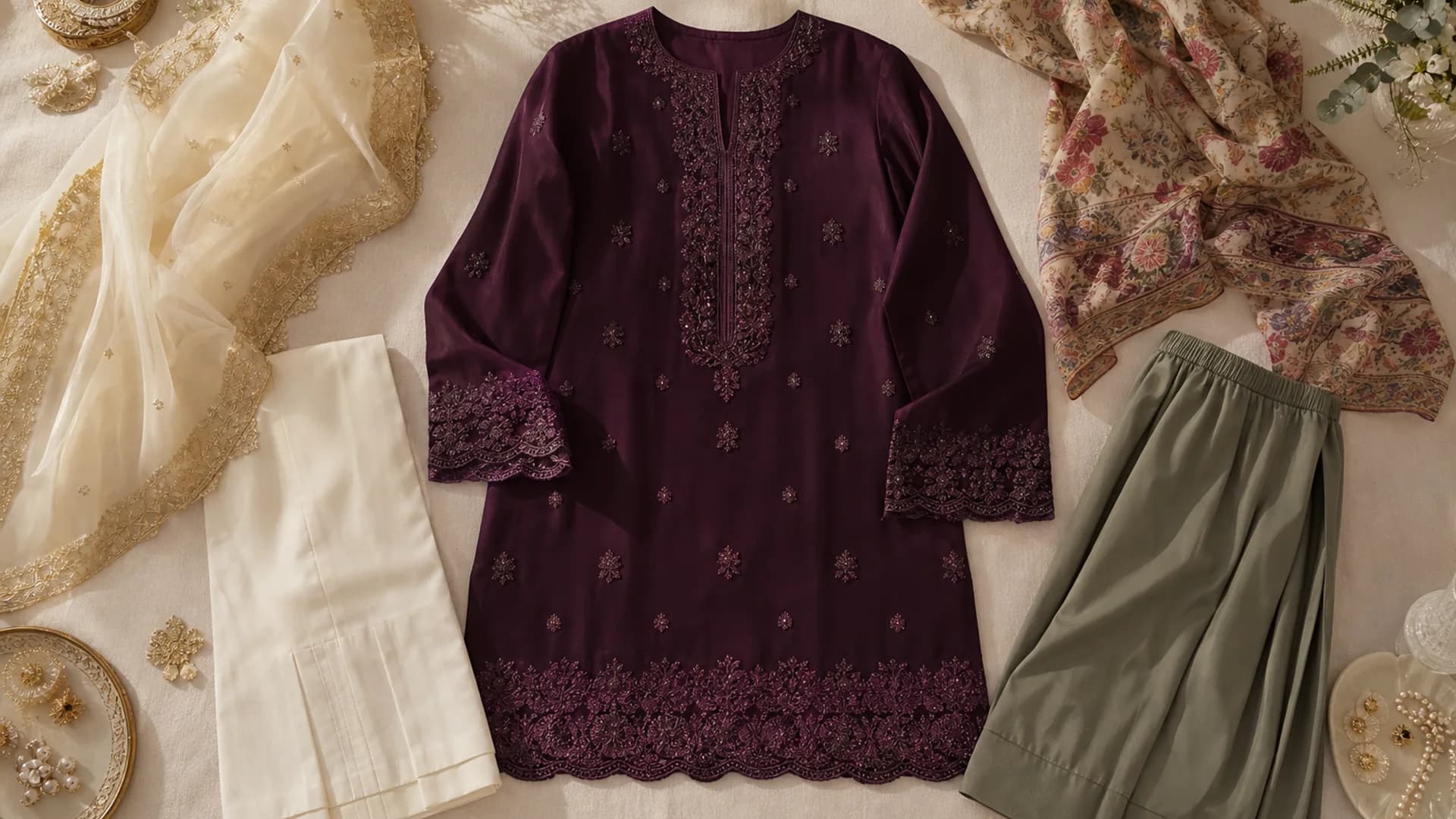
Eight Ways to Restyle a Formal Suit You Own
Most wardrobes hold three or four formal outfits that have been worn once and feel finished. Very little needs to change to make them wearable again.
Most Pakistani wardrobes contain three or four good formal outfits that have been worn once, are perfectly wearable, and feel finished — because they were photographed, and the people who would see them again were there the first time. That feeling is mostly wrong. What people remember from a function is a general impression: colour, and roughly how formal you looked. Very few people could describe the cut of your sleeve six months later. Which means an outfit needs to look *different*, not be different. And the amount that has to change to achieve that is much smaller than most people assume — usually one large element, not the whole thing. Here are eight ways to do it, roughly in order of effort.
1. Change the Dupatta
The single most effective change available, and the least effort. The dupatta is the largest visual element in the outfit and it is what people register first. Change it and the whole outfit reads differently. **A plain outfit with a worked dupatta** becomes a formal outfit. **A worked outfit with a plain dupatta** becomes semi-formal. **Change the fabric, not just the colour.** A soft chiffon and a crisp organza behave completely differently over the same shirt — one falls close, one creates volume. Our [dupatta fabric guide](/journal/dupatta-fabric-guide-chiffon-organza-net-silk) covers what each one does. **Go contrast rather than tonal**, or the reverse. If the original was matched, a contrast dupatta transforms it. **Or change the drape.** The same dupatta over one shoulder rather than across both is a genuinely different look, and it costs nothing. Our [draping guide](/journal/7-ways-drape-dupatta-weddings-formal-events) has the options. Buying two or three good dupattas is the cheapest way to expand a formal wardrobe, and it is what most people should do before buying another outfit.
2. Break Up the Three-Piece
A three-piece suit is three garments, and almost nobody treats it that way. **Wear the shirt with different trousers.** A formal kameez with plain ivory or black trousers is a different outfit from the same kameez with its matching pair. **Wear the trousers with a different shirt.** Formal trousers are frequently the most useful and least used piece in a wardrobe. **Wear the dupatta with something else entirely.** A good worked dupatta lifts several plain outfits. The barrier is psychological — the pieces came together and feel like a set. Once you stop treating them that way, four three-piece suits become considerably more than four outfits. **Where to be careful:** an exactly matched embroidered set can look odd split up if the work is clearly designed as a whole. Judge each piece on its own. Our post on [matching pieces bought separately](/journal/matching-dupatta-trouser-to-shirt-colour) covers pairing without a near-match, which is the risk here.
3. Change the Length
The alteration that changes the era of a garment more than any other. Shirt lengths move in and out of fashion faster than anything else in Pakistani wear, and a long shirt from a few years ago reads as dated in a way that has nothing to do with its quality. **Shortening is straightforward** unless there is a worked hem border, in which case a tailor can remove and re-apply it — more work, usually possible. **A very long shirt taken to mid-thigh** is close to a new garment, particularly worn with wide-leg trousers. **Lengthening is not practical** without adding a panel, which shows. So this alteration runs one way only. **Check the proportion against your own height**, not against the trend. Our [petite styling guide](/journal/how-to-look-taller-pakistani-suits-petite) covers where the hem should sit, and it should end above the widest part of the thigh or below the knee — never in between. Our post on [the five alterations that matter](/journal/five-alterations-make-any-suit-fit) covers what else a tailor can do to a finished garment.
4. Change the Trouser Shape
The bottom half of an outfit dates faster than the top, and it is the cheaper half to replace. **A fitted churidar swapped for wide-leg trousers** modernises an old formal shirt instantly. Wide-leg has replaced the fitted trouser as the standard, and the shift is very visible. **A straight trouser swapped for a sharara** turns a semi-formal outfit into a festive one. **A palazzo in a contrasting fabric** — plain silk under an embroidered shirt — reads as deliberate. Having one or two well-cut plain trousers made in good fabric is one of the highest-value purchases available, because they work under many shirts. Ivory and black are the obvious two; a deep neutral is the useful third. Our post on [sharara, gharara and palazzo](/journal/sharara-vs-gharara-vs-palazzo-difference) covers the shapes, and our [tailor guide](/journal/working-with-a-tailor-darzi-guide) covers briefing the measurements properly.
5. Change the Neckline
A cheap alteration with a disproportionate effect, because the neckline sits next to your face and is what people actually look at. **Deepening a shallow neckline** is quick and changes the whole feel of a garment. **Changing the shape** — a round neck to a V, or a V to a square — is more work but very visible. **Adding a placket or a keyhole** turns a plain neckline into a detail. **Removing a dated collar** — mandarin collars in particular date noticeably — modernises an older shirt. **One-way only:** you can always cut more away, but adding fabric back shows a join. So deepen, never raise. **Ask for the facing to be remade.** A deepened neckline with the original facing stretched over it gapes within a few wears, and that is what separates a good alteration from a bad one. Our [neckline guide](/journal/kameez-neckline-guide-which-suits-you) covers which shape suits which face and frame.
6. Add or Remove Embellishment
More involved, and worth it on a piece you like but do not wear. **Adding a worked border** to a plain hem or sleeve lifts a simple outfit to formal. Ready-made laces and borders are inexpensive and a tailor can apply them in an afternoon. **Adding a neckline patti** — an embroidered strip at the neckline — is the highest-value addition, because it sits where it shows most. **Removing embellishment** is the underrated direction. A dated heavily worked shirt with the applied lace taken off can become a clean modern piece, especially in a good fabric. **Replacing buttons** is trivial and changes the finish more than it should. **Where to be careful:** removing stitched-on embroidery leaves needle marks in fine fabric, and they may not close up. Test on an inside seam, and be more cautious with silk than with cotton. Our post on [embroidery types](/journal/embroidery-types-explained-zari-gota-resham) covers what can and cannot be safely removed.
7. Change the Jewellery and the Metal
No alteration, no cost, and more effective than it sounds. **Switch the metal.** The same outfit with gold jewellery and with silver reads as two different registers — one traditional and warm, one modern and cool. **Switch to pearls** for a restrained version of a formal outfit, suitable for a nikah where the original was worn to a walima. **Change where the emphasis sits.** Statement earrings and no necklace, then a necklace and small earrings. It changes what the eye reads first. **Add bangles** to make an outfit festive, or remove them to make it formal. **Change the hair.** Up rather than down does more in photographs than most people expect, which is why it is one of the three things that disguise a repeated outfit. Our post on [jewellery types](/journal/jewellery-explained-kundan-polki-gold-artificial) covers the materials, and the [accessories collection](/accessories) has hand-crafted pieces if you want something less common than the usual sets.
8. Move It Down a Level
The most underused option: wear a formal outfit somewhere less formal. A barat outfit will not be worn to another barat within the same circle for years. But the same shirt, with plain trousers and a simple dupatta and less jewellery, is an excellent outfit for a dinner, an Eid evening, or a family function. **Strip it down rather than matching it up.** Plain dupatta, minimal jewellery, flat shoes. **Split it.** The worked shirt alone with everyday trousers is often the most wearable part. **Accept some wear.** An outfit worn only to weddings is an expensive thing to own. Wearing it four times at a lower level is better value than keeping it perfect in a cupboard. This is the argument for buying fabric quality over embellishment in the first place — a heavily worked piece cannot move down a level, and a good silk in a restrained design can. Our post on [planning a wedding wardrobe](/journal/how-many-outfits-pakistani-wedding-week-budget) makes the same case, and the [stitched suits](/ladies/stitched-suits) in our [ladies collection](/ladies) are cut with that flexibility in mind.
Frequently Asked Questions
Change one large element rather than several small ones. The dupatta is the most effective — it is the biggest visual element and swapping fabric, colour or drape changes the whole outfit. Different jewellery and different hair complete the effect.
Yes, and most people should. Wear the shirt with different trousers, the trousers under a different shirt, and the dupatta over something plain. The barrier is psychological rather than practical. Be careful only with exactly matched embroidered sets designed as a whole.
Changing the shirt length, then changing the trouser shape. Shirt lengths move in and out of fashion faster than anything else, and swapping a fitted churidar for wide-leg trousers modernises an older formal shirt immediately. Shortening is easy; lengthening is not.
Applied lace and stitched-on borders usually can, and removing dated embellishment from a good fabric can produce a clean modern piece. But removal leaves needle marks that may not close up in fine fabric — test on an inside seam, and be more cautious with silk than cotton.
Far less than you think. What people remember from a function is colour and roughly how formal you looked, not the cut of a sleeve six months later. Change the dupatta, the jewellery and the hair and a repeat reads as a different outfit in photographs.
About the Author
Habiba Minhas
Founder and creative director of Habiba Minhas, Pakistan's leading handcrafted fashion brand based in Karachi. With a passion for preserving traditional Pakistani craftsmanship while embracing modern design, she has built a brand serving over 5,000 customers nationwide.
Specializing in premium ladies suits, kids festive wear, and baby products, Habiba works directly with artisan embroiderers and skilled tailors to create pieces that honor Pakistani heritage.
Related Articles
Formal Dressing in Your Forties and Fifties
There is a great deal of advice about what women over forty should stop wearing. Most of it is wrong. What actually changes is fit, fabric and comfort.
Original or Copy: How to Tell a Replica Suit
Master copies are sold openly and often honestly. The problem is when a copy is sold as an original at an original's price — here is how to tell.
Dressing for Ramadan and Iftar Gatherings
Ramadan runs a month, and the clothing has to work for fasting through the afternoon and hosting in the evening. The two are different problems.