

Sharara, Gharara or Palazzo: Which Is Which?
Three names, three genuinely different garments, and shops that use all three for the same thing. Here is how to tell them apart before you order.
Ask three shops for a sharara and you will be shown three different garments. One will be a soft flare from the thigh, one will have a joint at the knee with gathers below, and one will be a plain wide-leg trouser with a fancier name. Only one of those is a sharara. This matters more in 2026 than it has for a decade, because flared bottoms have come back properly. The sharara is the most requested silhouette of the year after years of straight-cut trousers and maxi shirts, and the gharara has held its place at weddings throughout. If you are ordering online, knowing which is which is the difference between the outfit you pictured and one you will not wear twice.
The Sharara: Flared From the Thigh
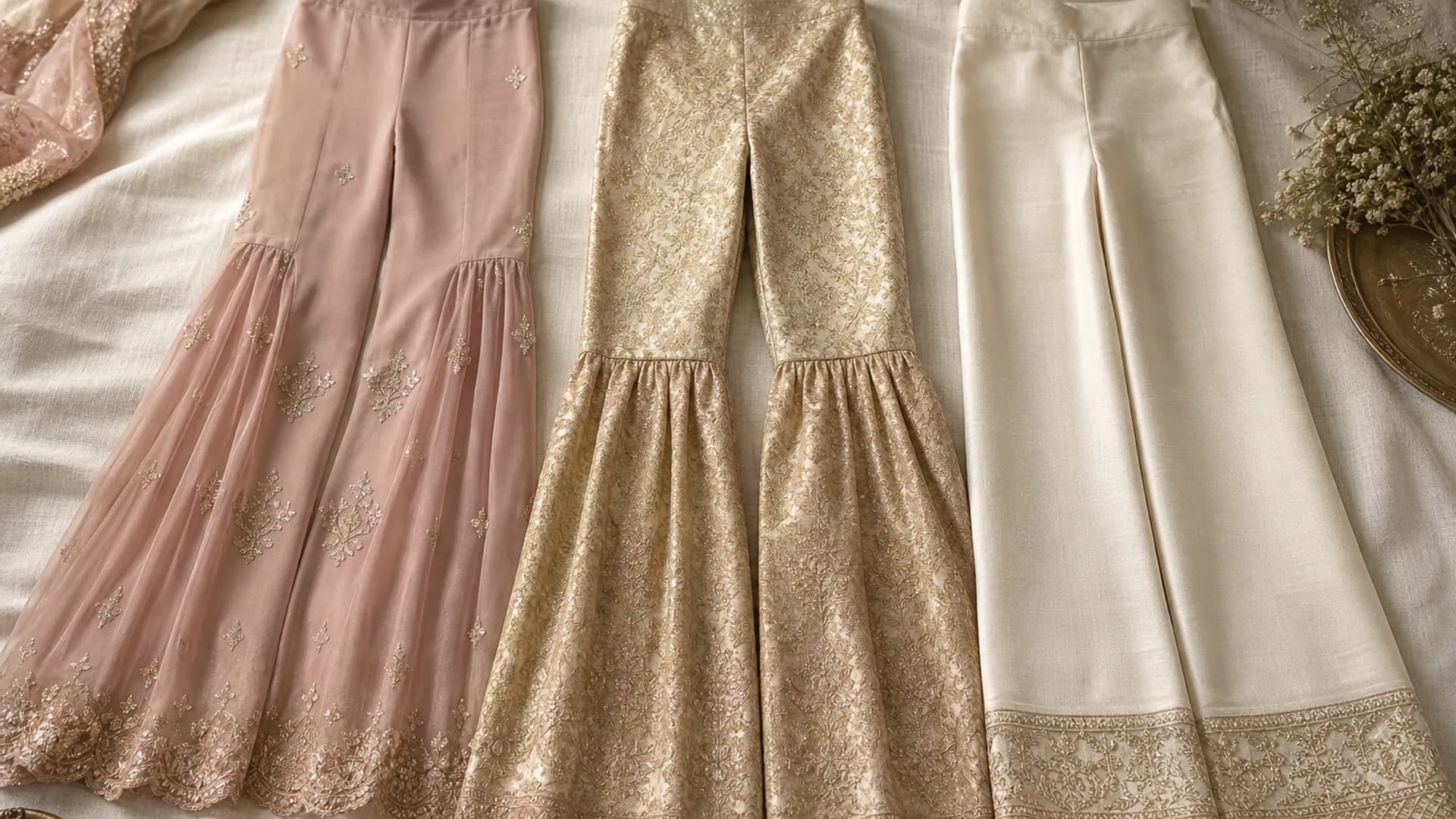
A sharara is a wide, flowing trouser that flares gradually from the thigh or upper knee down to a very wide hem. There is no joint and no gathering — it is cut as one continuous flare, usually from panels of fabric. The effect is soft and fluid. It moves like a long skirt but is genuinely two legs, so you can sit, climb stairs and dance without managing it. It is traditionally worn with a shorter kameez or kurti so the flare is visible — a long shirt over a sharara hides the entire point of it. The 2026 versions push this further, with high waistlines and shirts cut at or just below the hip. How to spot one in a photograph: the widening starts high, the line is smooth, and there is no horizontal seam breaking the leg.
The Gharara: Joined at the Knee
A gharara has a fitted leg from waist to knee, a decorative horizontal joint at the knee — the *goat* — and then a heavily gathered, pleated flare below it. That knee joint is the single identifying feature. If there is a visible band or seam at the knee with gathers falling from it, it is a gharara. If there is not, it is not. The gharara is the older and more formal of the two. It comes from Awadhi and Lucknawi court dress, and it carries far more fabric — a traditional gharara can use several metres per leg, which is why it has such weight and movement. It is the wedding garment of the two. Ghararas are what you see at nikahs and barats, often in banarsi or jamawar, and the farshi gharara — with an exaggerated flare that pools on the floor — has had a strong revival for brides and close family. Practical note: a gharara is heavy and it does not fold small. If you are travelling to a wedding, this is the outfit that needs its own bag.
The Palazzo: Straight and Wide
A palazzo is a wide-leg trouser that is roughly the same width from hip to hem. No flare, no joint, no gathering — just volume, cut straight. It is the least traditional of the three and the most wearable day to day. Palazzos have quietly become the standard bottom for a large number of Pakistani women in 2026, replacing the shalwar for work and everyday wear entirely. They are also the most forgiving to buy online, because there is no complicated construction to get wrong. Length is the only real risk — a palazzo cut for someone taller drags on the ground, and there is no hem allowance to let out. The distinction that matters commercially: a palazzo is a trouser. A sharara and a gharara are festive garments. A shop describing a plain wide-leg trouser as a sharara is telling you about the price, not the cut.
Which One Suits Which Body
All three add volume below the waist, so the question is where you want that volume to start. **Petite frames.** A sharara, with a high waist and a short kurti. The flare starting high creates a long unbroken line. A gharara's knee joint cuts the leg horizontally at exactly the wrong point and will make you look shorter. **Tall frames.** Anything, and the gharara particularly — you have the length to carry the knee break and the volume below it. **Fuller hips.** A palazzo or a sharara that flares from the thigh rather than the hip. Avoid gathering at the waistband; look for panelled or flat-fronted construction instead. **Fuller through the middle.** A high-waisted sharara with a shorter kurti works better than a long shirt, which most people assume is the safer choice. The high waist defines the narrowest point and the flare does the rest. The general rule: pair volume with a fitted or shorter top. Volume on volume — a long loose shirt over a gharara — reads as shapeless no matter how good the fabric is.
Fabric Decides Whether It Works
These are silhouettes built entirely on how fabric falls, so the fabric is not a detail. **Sharara** needs drape. Chiffon, georgette, crepe and soft silk all fall properly. A sharara in a stiff fabric stands away from the leg and looks like a tent rather than a flare. **Gharara** needs weight and body. Banarsi, jamawar, raw silk and brocade hold the pleats below the knee. A gharara in soft chiffon collapses and the gathers disappear entirely. **Palazzo** takes almost anything. Crepe and cotton for everyday, raw silk for formal. This is the single most common online-ordering mistake with all three — a shape that is correct in the photograph and wrong in the parcel because the fabric was substituted. Our [fabric glossary](/content/fabric-glossary) covers what the names on the label actually mean, and the [summer and winter guide](/journal/summer-vs-winter-fabric-guide-pakistani-women) covers how each behaves in Pakistani heat.
Where Each One Belongs
**Gharara** — barat, nikah, walima, and formal family functions. It is the most ceremonial of the three and reads as too much anywhere below that. **Sharara** — Eid, mehndi, dholki, engagements, semi-formal dinners, and weddings when you are a general guest rather than close family. The most versatile of the three by a distance. **Palazzo** — everyday, office, casual Eid visits, and as a formal bottom when cut in silk. A sharara in chiffon with a plain kurti is the single most useful festive purchase of the three, because it moves between an Eid morning and an evening dinner with only a change of dupatta and jewellery. Our [Eid outfit guide](/journal/best-eid-outfits-women-pakistan-2026) and the [formal wear guide](/journal/pakistani-formal-wear-guide-party-semi-formal-festive) both map this in more detail, and you can see the range across our [ladies collection](/ladies).
Buying Any of the Three Online
**Ask for the flat measurement of the hem.** This is the number that tells you what you are actually getting. A genuine sharara hem is wide — if a shop quotes something close to a normal trouser, it is a palazzo with a better name. **Ask where the flare starts.** Thigh, knee, or nowhere. This one question separates all three. **Check the length carefully.** All three are meant to sit at or just above the floor with heels. Too short is unfixable; too long can usually be hemmed, though a gharara cannot be shortened below the knee joint without destroying the construction. **Check the waistband.** Elasticated is comfortable and forgiving; a flat front with a side zip is cleaner under a fitted kurti. Neither is wrong, but they fit differently. **Ask about the lining.** A chiffon sharara without lining is not wearable, and this is regularly omitted from product photographs. Our guide on [what to check when buying unstitched online](/journal/5-things-check-buying-unstitched-suit-online-pakistan) applies here too, and the [size guide](/content/size-guide) has our measurements. If you are unsure how a shape will look on you, the [Virtual Try Room](/virtual-try-room) is worth using before ordering.
Frequently Asked Questions
A sharara flares smoothly from the thigh with no joint. A gharara has a fitted leg to the knee, a decorative horizontal joint there, and heavy gathers falling below it. The knee joint is the identifying feature — if there is no joint, it is not a gharara.
No. A palazzo is straight and roughly the same width from hip to hem. A sharara starts narrower and flares out. Shops often use 'sharara' for wide-leg trousers because it sounds more festive, so ask where the flare starts and what the hem measures.
A gharara for close family at a barat, nikah or walima — it is the more ceremonial of the two and carries heavy fabrics well. A sharara for general guests and for mehndi, dholki and Eid. A sharara is also far more wearable a second time.
Yes, and better than a gharara does. Choose a high waist and a shorter kurti so the flare starts high and the leg line stays unbroken. A gharara's knee joint cuts the leg horizontally and tends to make shorter frames look shorter.
A short kurti or a kameez ending at or just above the hip, so the flare is visible. A long shirt covers the widening and removes the whole reason for choosing a sharara. Keep the top relatively fitted — volume on top of volume reads as shapeless.
About the Author
Habiba Minhas
Founder and creative director of Habiba Minhas, Pakistan's leading handcrafted fashion brand based in Karachi. With a passion for preserving traditional Pakistani craftsmanship while embracing modern design, she has built a brand serving over 5,000 customers nationwide.
Specializing in premium ladies suits, kids festive wear, and baby products, Habiba works directly with artisan embroiderers and skilled tailors to create pieces that honor Pakistani heritage.
Related Articles
Eight Ways to Restyle a Formal Suit You Own
Most wardrobes hold three or four formal outfits that have been worn once and feel finished. Very little needs to change to make them wearable again.
Formal Dressing in Your Forties and Fifties
There is a great deal of advice about what women over forty should stop wearing. Most of it is wrong. What actually changes is fit, fabric and comfort.
Original or Copy: How to Tell a Replica Suit
Master copies are sold openly and often honestly. The problem is when a copy is sold as an original at an original's price — here is how to tell.