

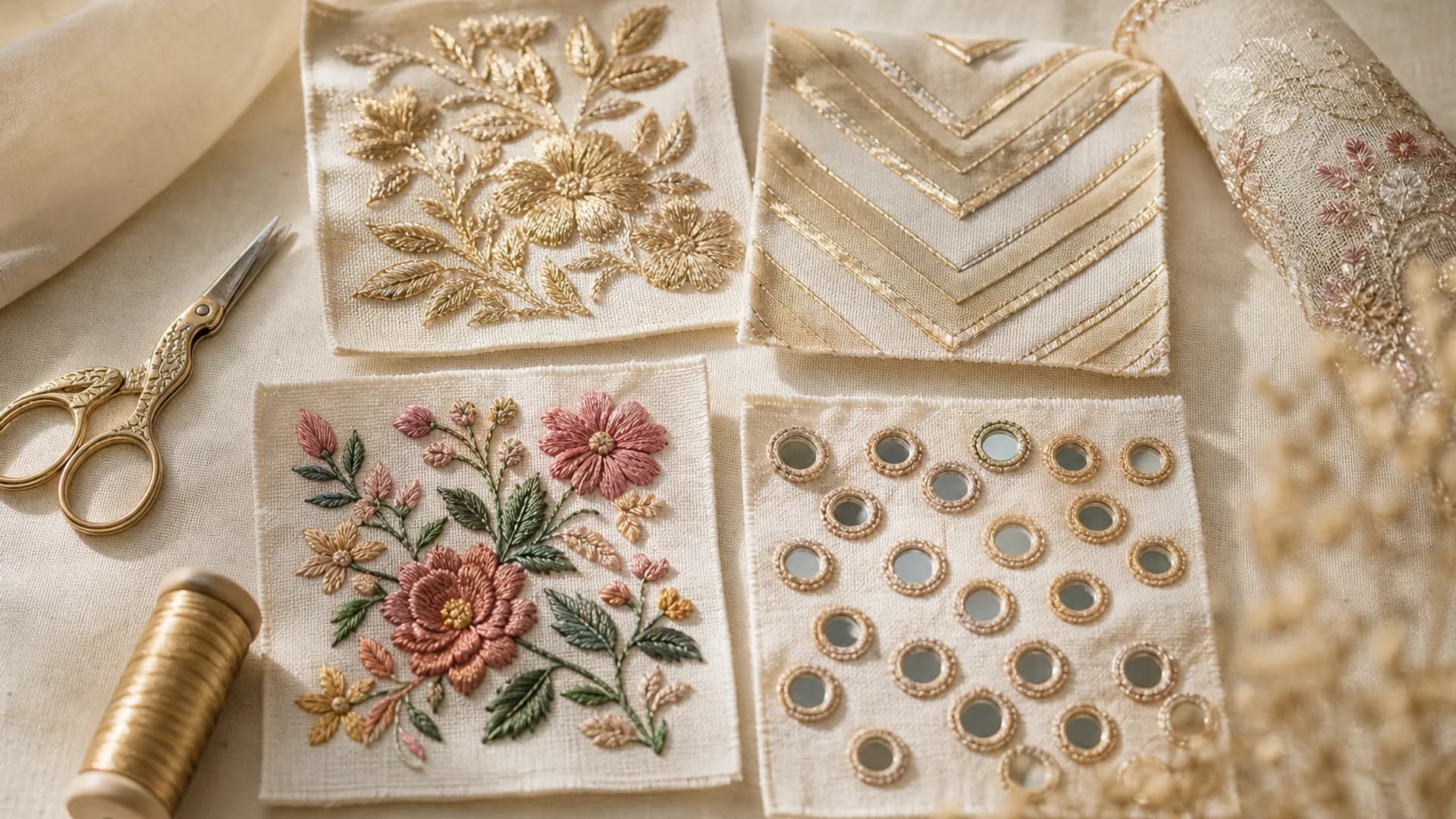
Zari, Gota, Resham: Embroidery Types Explained
Every formal suit is described with a list of embroidery names, and almost nobody knows what they mean. Here is what each one is, and how it behaves.
Read the description of any Pakistani formal suit and you will find a list: zari, dabka, nakshi, gota, resham, sequins, mirror work. Often four or five of them in one sentence. Almost nobody buying knows what those words mean, which is a problem for two reasons. The first is price — the difference between a suit with hand-done dabka and one with machine-run resham is substantial, and the labels are how you tell them apart. The second is care. These materials behave completely differently in a wash, in storage and against skin, and the same care instruction cannot be right for all of them. This is what each one actually is, what it costs, and what it needs from you.
Zari: Metallic Thread
Zari is metallic thread, and it is the foundation of Pakistani formal embellishment. Traditionally it was real gold or silver wound around a silk core. Almost all zari today is a metal-coated polyester or a copper alloy, which is why the price range is enormous — genuine gold zari is a different product from the coated thread on a mid-range suit, though they look similar when new. **How it looks:** flat, smooth, reflective. It lies close to the fabric rather than standing up from it. **How it wears:** the coating rubs off along fold lines and at friction points — cuffs, the dupatta shoulder, the waist. This is why zari on a well-cared-for suit still looks good after ten years and zari on a folded, unwrapped one looks patchy after two. **How it ages:** it tarnishes. Real zari darkens gently; coated zari goes black, and humidity accelerates it dramatically. **Care:** never store in plastic, never machine wash, wrap in muslin. Our [storage guide](/journal/how-to-store-formal-suits-pakistan) covers the method — zari is the most storage-sensitive material in a Pakistani wardrobe.
Dabka and Nakshi: Coiled Wire
These are the ones that push the price up, and they are worth understanding because they are the marker of genuine hand work. **Dabka** is a fine metal wire coiled into a tight spring, cut into short lengths, and stitched on like a bead. It sits raised off the fabric and has a dense, slightly matte glitter. Dabka is the material behind almost all heavy Pakistani bridal and formal work. **Nakshi** is a similar coiled wire but with a faceted or twisted surface, so it catches light more sharply than dabka's soft shimmer. **Both are applied by hand, one piece at a time.** There is no machine shortcut. That is the whole reason a heavily dabka-worked outfit costs what it does — it is hours of labour, not material cost. **How they wear:** the coil can catch and unravel if a thread is pulled. A single snagged piece can run, so a loose one should be secured immediately rather than at the end of the season. **Care:** dry clean only, and tell the cleaner it is dabka work. Never iron directly over it — the coil flattens and does not recover.
Resham: Silk Thread
Resham simply means silk thread — coloured embroidery worked in silk or a silk-like rayon rather than metal. **How it looks:** soft sheen, full colour range, and it can be worked in fine detail. Floral motifs, vines and figurative work are usually resham. **Machine or hand?** Both, and this is where most of the price variation sits. Machine resham is fast, extremely regular, and identifiable by perfectly even stitches and a dense backing thread visible on the reverse. Hand resham has small irregularities, and the reverse looks different from the front rather than like a mirror of it. **Turn the fabric over.** This is the most useful test available for any embroidery. Machine work has a uniform, often messy backing with long floats and a visible bobbin thread. Hand work has knots and a tidier, more varied reverse. **How it wears:** well. Resham is the most durable of the decorative materials because it is thread rather than metal or applied elements. **Care:** colours can bleed on a first wash, particularly deep reds on ivory. Test on an inside seam, and dry clean anything pale.
Gota and Applied Work
**Gota** is a flat woven metallic ribbon, applied to the fabric in strips, folds or shapes rather than stitched as thread. Gota patti is the technique of folding it into leaves and petals. It is strongly associated with mehndi and festive wear, particularly in yellows, greens and brights, and it has an unmistakable flat metallic shine and geometric quality. Our [mehndi guide](/journal/what-to-wear-mehndi-night-pakistan) covers where it belongs. **Mirror work (shisha)** is small mirrors held on with a stitched frame of thread. Traditional to Sindh and Balochistan, festive, and it catches light beautifully in a dark room. Modern versions use plastic or acrylic discs rather than glass — worth knowing, because plastic can soften and warp in a hot cupboard. **Sequins** are flat discs. Cheap, effective and everywhere. The important limitation: plastic sequins soften in heat and can fuse to whatever is folded against them in a Pakistani summer cupboard. **Tilla** is a flat metallic strip laid on the surface, used heavily in Kashmiri and northern work. **Applied lace and borders** are pre-made trims stitched on. Fast, inexpensive, and the reason two suits can look similar at very different prices.
Telling Hand Work From Machine
Four checks, none requiring expertise. **Turn it over.** Machine embroidery has a regular, dense backing with a visible bobbin thread and long float threads between motifs. Hand work has knots, and the reverse looks quite different from the front. **Look for irregularity.** Hand work has small variations in stitch length and motif spacing. Perfect repetition across a metre of fabric is a machine. **Check the raised elements.** Dabka, nakshi and mirror work are applied by hand by definition. A suit with genuine dabka is hand-worked whatever else is on it. **Feel the back.** Machine work is often backed with a stabiliser — a stiff layer that stays in the garment and can be scratchy. Hand work usually is not. None of this makes machine work bad. Machine resham on a good silk is a perfectly sound purchase and far more affordable. It only matters that you know which you are paying for. Our [quality checklist for children's wear](/journal/quality-kids-festive-outfit-mothers-buying-checklist) applies the same inspection method.
Comfort: The Part Nobody Mentions
Embroidery is on the outside, but you feel it on the inside, and this decides whether an outfit gets worn twice. **Check the reverse of any worked area that touches skin.** The neckline, the inside of the sleeve and the shoulder are where problems occur. Exposed knots and cut thread ends are scratchy after twenty minutes and unbearable after three hours. **A lined worked area is far more comfortable.** A good maker lines behind the embroidery for exactly this reason. Ask. **Heavy work on the shoulders is tiring.** The weight sits on a small area and a very heavily worked shirt is genuinely hard to wear through a long function. **Sharp-backed stones and dabka catch on dupattas** and on jewellery. A worked neckline plus a net dupatta is a combination that snags. **Test before the day.** An hour at home in the full outfit tells you what four hours at a wedding will feel like. Our [fuller figure guide](/journal/fuller-figure-pakistani-formal-wear-guide) and [petite guide](/journal/how-to-look-taller-pakistani-suits-petite) cover where placement should sit for different frames.
Placement, Which Matters as Much as Type
The same embroidery in a different place produces a completely different outfit. **Neckline work** is the highest-value placement. It sits near the face, it is in every photograph, and it does the most for the least material. **Sleeve and cuff work** is visible when you move and gesture, which at a Pakistani function is constantly. **Hem borders** anchor an outfit and add formality without adding weight to the shoulders. **All-over body work** is the most expensive and the least flattering on most frames — it removes the shape of the garment and adds visual bulk. **Dupatta borders** are the best value of all. A worked dupatta over a plain shirt gives you two outfits, because swapping it changes everything. Our [dupatta fabric guide](/journal/dupatta-fabric-guide-chiffon-organza-net-silk) covers which fabrics carry which work. The practical rule: work near the face and at the edges reads as considered. Work everywhere reads as expensive, which is not the same thing. You can see how we place it across the [3-piece suits](/ladies/3-piece-suits) and the [ladies collection](/ladies).
Frequently Asked Questions
Zari is flat metallic thread stitched close to the fabric with a smooth reflective finish. Dabka is fine metal wire coiled into a spring, cut and stitched on like a bead, so it sits raised with a dense glitter. Dabka is applied by hand piece by piece, which is why it costs more.
Turn the fabric over. Machine work has a dense regular backing with a visible bobbin thread and long floats between motifs; hand work has knots and a reverse that looks quite different from the front. Also look for small irregularities in stitch length — perfect repetition is a machine.
Because it is metal, and metal tarnishes on contact with air and moisture. Most zari today is metal-coated rather than solid gold or silver, and the coating darkens faster. Humidity speeds it up considerably, and storing the garment in a plastic bag is the fastest way to ruin it.
Gota is a flat woven metallic ribbon applied to fabric in strips or folded shapes rather than stitched as thread — gota patti is the technique of folding it into leaves and petals. It has a flat geometric shine and is strongly associated with mehndi and festive wear.
Usually the reverse of the work rather than the front — exposed knots and cut thread ends at the neckline, shoulder or inner sleeve. A well-made suit is lined behind the embroidery for exactly this reason. Machine work backed with a stiff stabiliser is the other common cause.
About the Author
Habiba Minhas
Founder and creative director of Habiba Minhas, Pakistan's leading handcrafted fashion brand based in Karachi. With a passion for preserving traditional Pakistani craftsmanship while embracing modern design, she has built a brand serving over 5,000 customers nationwide.
Specializing in premium ladies suits, kids festive wear, and baby products, Habiba works directly with artisan embroiderers and skilled tailors to create pieces that honor Pakistani heritage.
Related Articles
Winter Fabrics: Khaddar, Karandi, Velvet and More
Pakistani winter fabrics are sold by name and almost never explained. Here is what each one is, how warm it really is, and where it belongs.
Lawn Season: How to Buy Lawn Actually Well
Lawn season is the one shopping event the whole country takes part in, and most of it is bought in a rush on a phone. Here is how to judge what you are buying.
How to Store Formal Suits So They Last Years
A formal suit spends most of its life in a cupboard, and that is where most of them are ruined — not by wearing but by waiting.