
What to Wear So You Photograph Well
The outfit that looks best in the room is not always the one that looks best in the photographs, and Pakistani function lighting is unusually unkind.
Everyone has had the experience: an outfit that looked excellent in the mirror, and then the photographs come back and it looks flat, or the colour is wrong, or the embroidery has disappeared into a dark shape. That is not usually a fault in the outfit. It is a mismatch between how a fabric behaves in ordinary daylight and how it behaves under the lighting Pakistani functions actually use — warm string lights, marquee spotlights, a photographer's direct flash, and increasingly a videographer's LED panel pointed at your face. Those are unusual lighting conditions, and they treat colours and fabrics very differently from a bedroom mirror. Since the photographs are what survives the evening, it is worth understanding which choices hold up.
How Function Lighting Actually Works
Four kinds of light, and each does something different. **Warm string lights and lamps.** The standard at outdoor and marquee functions. They push everything toward yellow-orange. Cool colours — powder blue, lilac, mint, cool grey — go dull and greyish. Warm colours glow. **Direct flash.** A photographer's on-camera flash flattens texture completely and blows out pale colours. White and very pale pastels lose all detail; black loses all detail in the other direction. **LED video panels.** Bright, cool and unforgiving, pointed directly at your face. These make heavy makeup obvious and make shiny synthetic fabric look plastic. **Daylight.** The most flattering, and it applies at nikahs and daytime functions. Everything reads truer. The practical implication: **a daytime nikah and a midnight barat need different colours**, and the same outfit will not photograph the same way at both. Our [nikah guide](/journal/nikah-outfit-guide-guests-pakistan) and [barat guide](/journal/barat-outfit-ideas-guests-pakistan) cover the wider differences between the functions.
Colours That Hold Up
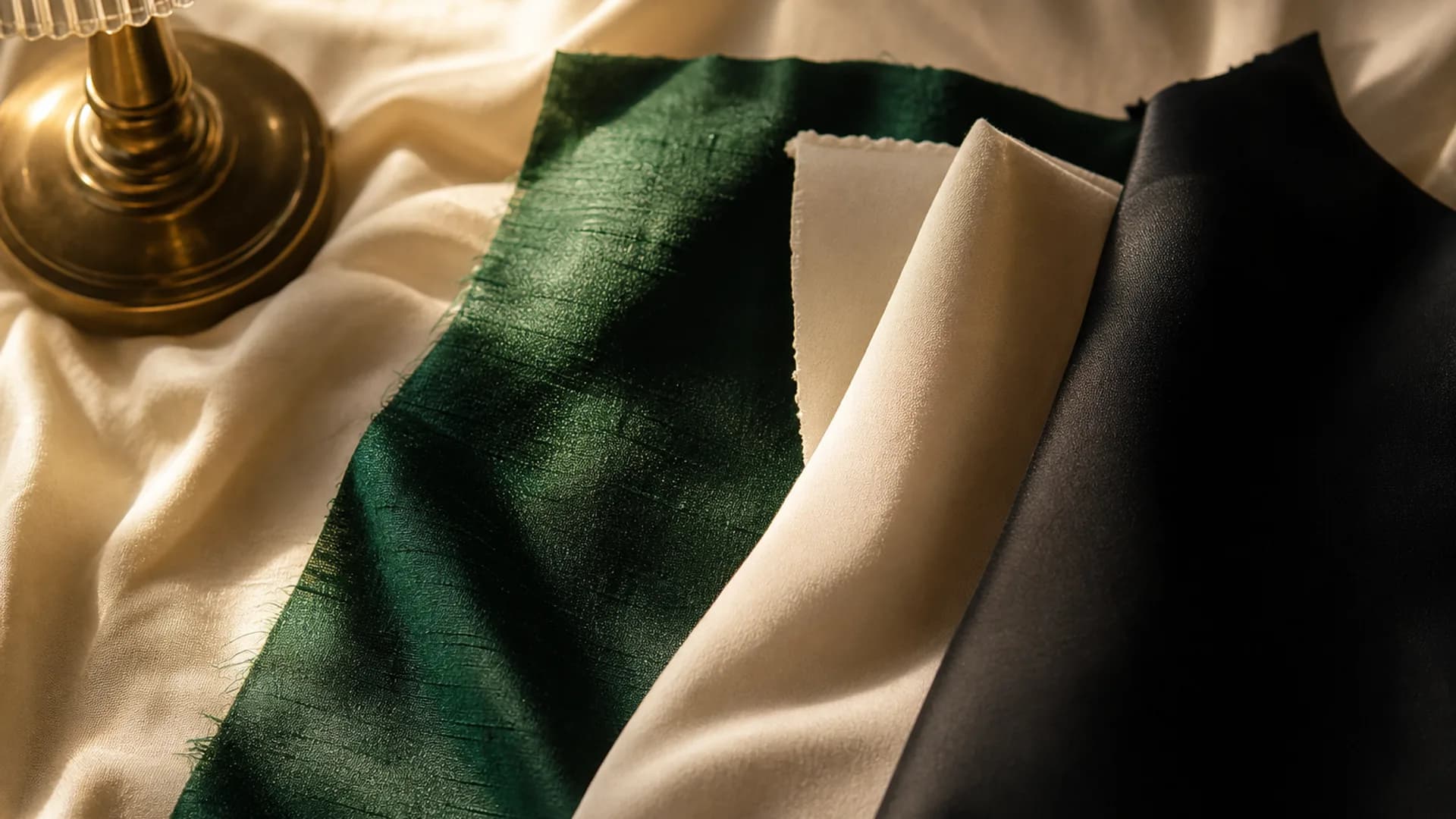
**Jewel tones photograph best under warm evening light.** Emerald, sapphire, plum, teal, ruby, deep rose. They have enough saturation to survive both warm light and a flash, and they read as rich rather than dark. **Warm neutrals** — champagne, bronze, gold, stone, chocolate — glow under warm lighting and are consistently flattering. **Ivory beats pure white.** White blows out under flash and goes grey under warm light; ivory holds detail in both. **Deep colours with texture** — a raw silk plum, a velvet emerald — are the most reliable choice for an evening function. **What struggles:** **Cool pastels under warm light.** Powder blue, lilac and mint go grey and lifeless. They photograph beautifully in daylight, which is why they belong at a daytime nikah rather than a midnight barat. Our post on [sage and mint green](/journal/sage-mint-green-pakistani-fashion-2026) covers where the pale end belongs. **Pure black under flash.** All detail disappears and the outfit becomes a silhouette. Our post on [wearing black](/journal/how-to-wear-black-pakistani-formal-wear) covers what rescues it — texture and a metallic dupatta. **Neon and very bright saturated colours**, which oversaturate on camera and are hard to correct afterwards.
Texture Beats Embellishment
The most useful thing to understand: **a camera reads texture better than it reads applied decoration.** A raw silk with visible slub, a velvet with a pile, a jamawar with a woven pattern — all of these have dimension that survives a flash. The light catches unevenly across the surface, which is what makes a fabric look expensive in a photograph. A flat synthetic has one uniform surface. Under a flash it produces a hard bright highlight and nothing else, which is exactly what "cheap" looks like in an image. **Embroidery photographs less well than people expect.** Dense flat thread work reads as a texture at distance rather than as a pattern, and in a dark room it disappears entirely. Raised work — dabka, nakshi, mirror — catches light and does survive. Our post on [embroidery types](/journal/embroidery-types-explained-zari-gota-resham) covers which is which. **Sequins and metallic work photograph very well** under a flash, sometimes too well — a fully sequinned outfit can blow out into a bright mass. **The practical conclusion:** for an evening function, a good textured fabric with restrained placed work photographs better than a flat fabric with heavy embroidery, and usually costs less.
The Colour Nearest Your Face
In a portrait, the colour immediately below your chin does more than everything else in the outfit combined, because it reflects up onto your skin. **Warm tones near the face** — gold, champagne, warm ivory, coral — reflect warmth upward and are flattering on most Pakistani skin tones. **Cool tones near the face** can drain colour, particularly under a cool LED panel. **Black near the face** casts a shadow upward and emphasises under-eye shadows on many people. This is why worked necklines on black outfits are so common — they put something reflective between the black and your skin. **Green near the face** can cast a slight colour onto skin under strong light, which is worth knowing if you are in a full green outfit under a green-tinted marquee. **The fix in every case is the same:** put something between the colour and your face. A contrast dupatta over one shoulder, a worked neckline, or reflective earrings at the jawline. All three lift the face. Our guide to [colours for Pakistani skin tones](/journal/best-colours-for-pakistani-skin-tones) covers testing this on yourself, and the [Virtual Try Room](/virtual-try-room) will show you before you buy.
Fit Shows More in a Photograph
A camera flattens three dimensions into two, which removes most of the information the eye uses to forgive a poor fit. **A dropped shoulder is the most visible fit problem in a photograph.** In person it reads as slightly loose; in an image it reads as a garment that does not fit. Our post on [the five alterations that matter](/journal/five-alterations-make-any-suit-fit) covers why the shoulder is the measurement to buy for. **A dragging hem is the second.** It shortens the whole figure and it is instantly visible in a standing photograph. **Pulling across the bust or hip** shows as horizontal stress lines that are far more obvious in an image than in a mirror. **A sleeve that is too long** covers the hand and shortens the arm. **Standing photographs are unforgiving of length.** Most function photographs are full-length group shots, which is exactly the format that exposes proportion. Our [petite guide](/journal/how-to-look-taller-pakistani-suits-petite) covers where hemlines should sit. **The general point:** a simple well-fitting outfit photographs better than an elaborate one that fits approximately, every time.
Group Photographs
Most function photographs are groups, which is a different problem from a portrait. **Coordinate the palette, not the exact shade.** A family in one colour family at different depths photographs far better than everyone in identical outfits, and it lets each person wear a shade that suits her. **Vary the depth.** If three people wear the same mid-tone, they merge in an image. A pale, a mid and a deep read as three distinct figures. **Avoid busy prints in a group.** At distance a print becomes visual noise, and several people in prints becomes a mess. Solid colours and subtle textures hold up. **Think about where you will be standing.** If everyone else is in pastels, a deep jewel tone stands out — which may or may not be what you want. **Check what the bride is wearing** for each function so you are not in the same colour family. Our post on [planning a wedding wardrobe](/journal/how-many-outfits-pakistani-wedding-week-budget) covers coordinating across a week. **Get your own photographs early.** Hair and makeup look best in the first hour, and formal group photographs at Pakistani functions often happen late.
Practical Notes
**Check the outfit under a phone flash at home.** Take a photograph of yourself in it with the flash on, in a dim room. It takes ten seconds and it tells you almost everything on this page for your specific outfit. **Check it in daylight too**, by a window, for the daytime functions. **Lint and creases show more in photographs**, particularly on dark fabric. Steam before leaving and carry a lint roller. Our [packing guide](/journal/packing-formal-wear-travel-without-creasing) covers steaming without damaging embroidery. **A dupatta across the chest widens you in an image.** Over one shoulder is more flattering in photographs as well as in person. Our [draping guide](/journal/7-ways-drape-dupatta-weddings-formal-events) has the options. **Very shiny synthetic fabric produces a hard white highlight** under flash. If a fabric looks glassy in a mirror, it will look plastic in an image. Our post on [telling real silk from fake](/journal/how-to-tell-real-silk-from-fake-pakistan) covers the difference, and the reason a real silk photographs so much better is exactly this. You can see the fabrics we work with across the [ladies collection](/ladies) and the [3-piece suits](/ladies/3-piece-suits).
Frequently Asked Questions
Jewel tones — emerald, sapphire, plum, teal, deep rose — and warm neutrals like champagne, bronze and stone. They have enough saturation to survive warm string lighting and a direct flash. Cool pastels go grey under warm light, and pure black loses all detail under flash.
Usually the fabric. A camera reads texture better than applied decoration, so a raw silk or velvet with real surface variation photographs rich, while a flat synthetic produces one hard highlight and nothing else — which is what 'cheap' looks like in an image.
Pure white blows out under a direct flash and loses all detail, and it goes slightly grey under warm string lighting. Ivory or champagne holds detail under both and is more flattering against most skin tones, which is why it has become the standard alternative.
Share a colour family but vary the depth — a pale, a mid-tone and a deep shade read as three distinct figures, while three people in the same mid-tone merge together. Avoid busy prints, which become visual noise at distance in a group shot.
Take a photograph of yourself in it with your phone flash on, in a dim room, and another by a window in daylight. It takes ten seconds and shows you exactly how the colour, texture and fit will read under the two lighting conditions that matter.
About the Author
Habiba Minhas
Founder and creative director of Habiba Minhas, Pakistan's leading handcrafted fashion brand based in Karachi. With a passion for preserving traditional Pakistani craftsmanship while embracing modern design, she has built a brand serving over 5,000 customers nationwide.
Specializing in premium ladies suits, kids festive wear, and baby products, Habiba works directly with artisan embroiderers and skilled tailors to create pieces that honor Pakistani heritage.
Related Articles
Gifting Clothes: How to Buy for Someone Else
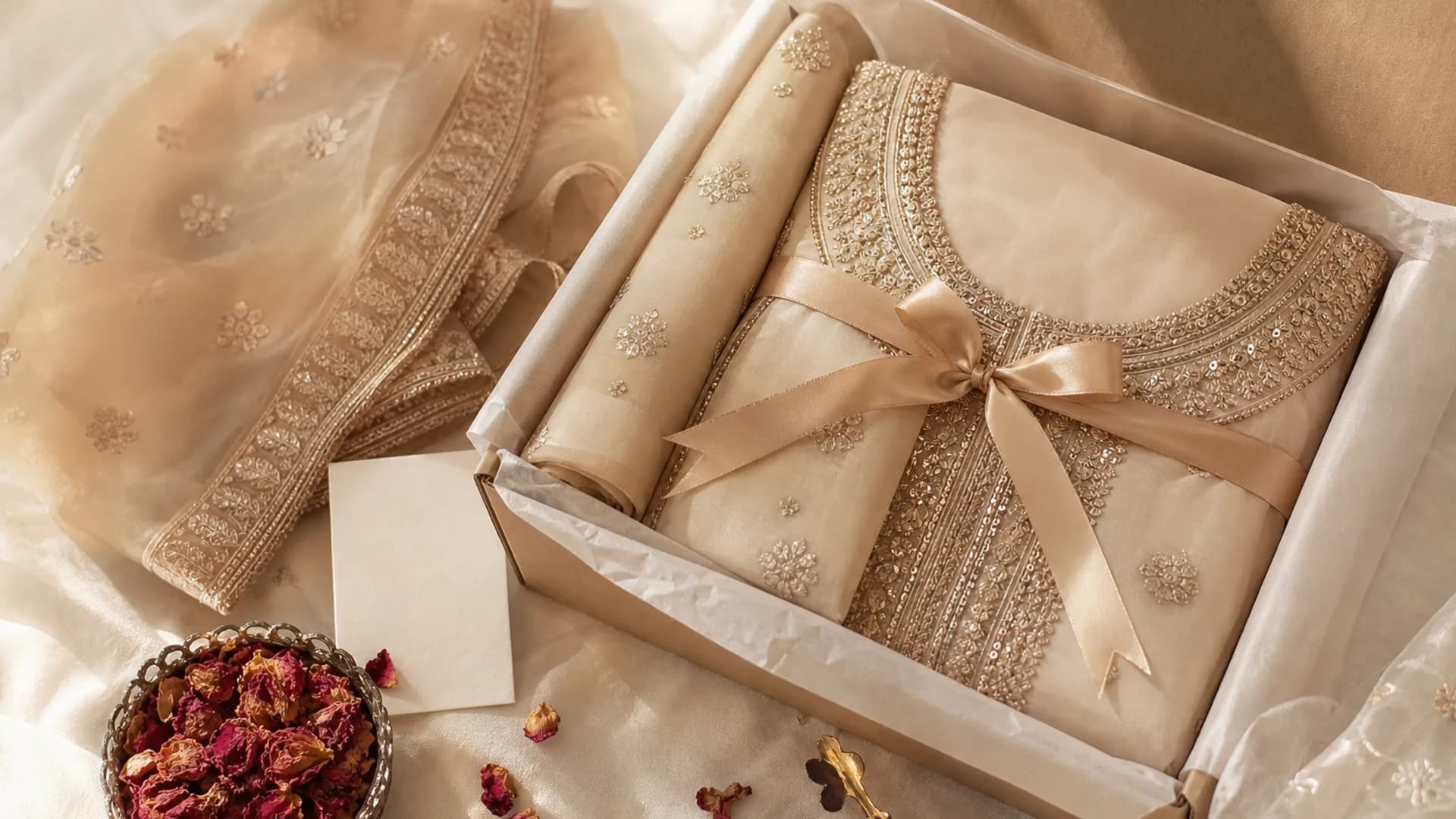
Clothes are the default gift in Pakistani households and the one most often quietly put away. A few rules make the difference.
Sleeve Styles: Which One Suits Your Arms
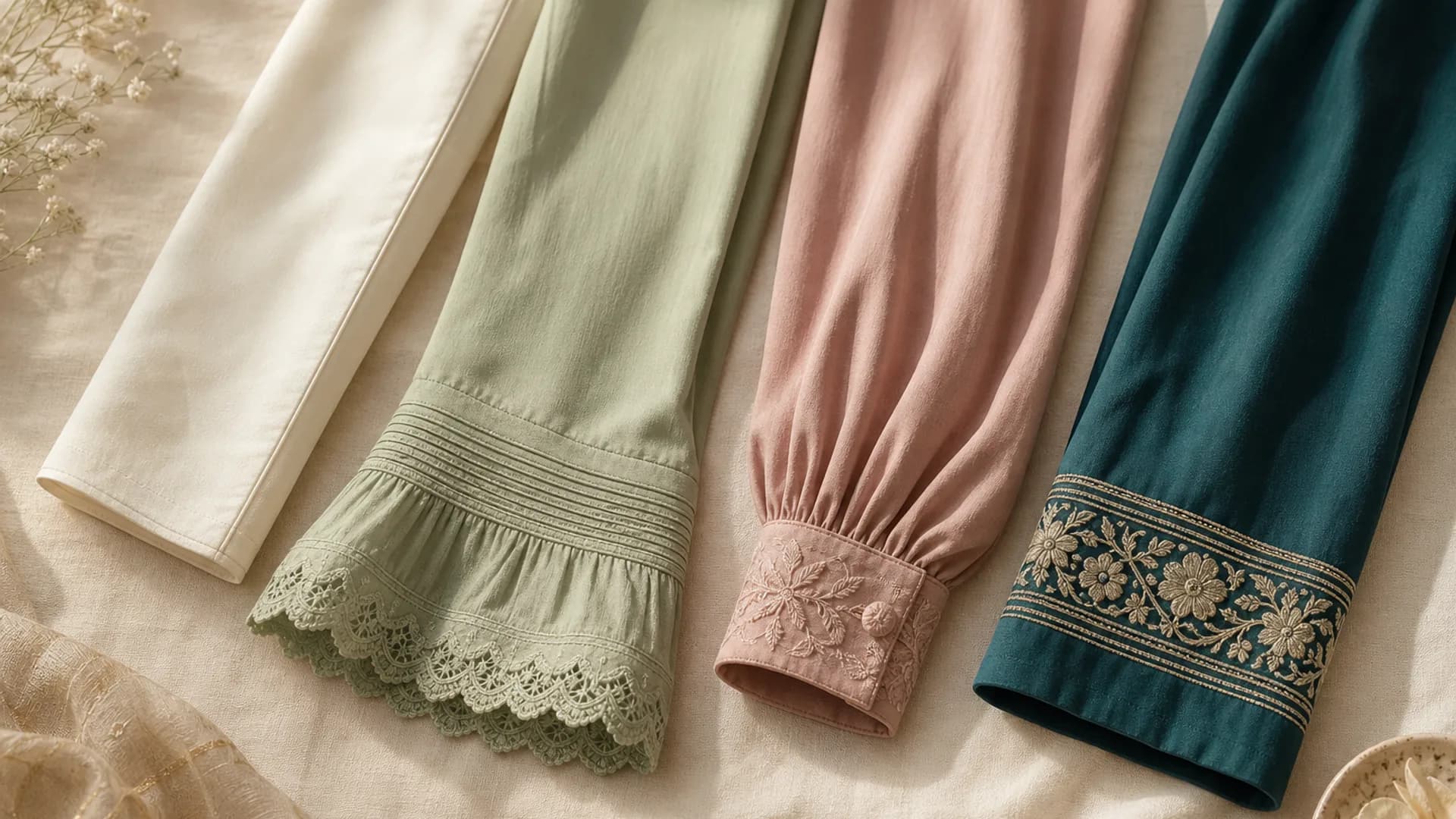
The sleeve is half the visible surface of a kameez and the most common fit complaint. Here is what each style does and which arms it suits.
Left It Late? Eid Shopping in the Last Week
Eid is in four days and nothing in the cupboard works. Here is what is genuinely still possible, in order of how little time each option needs.